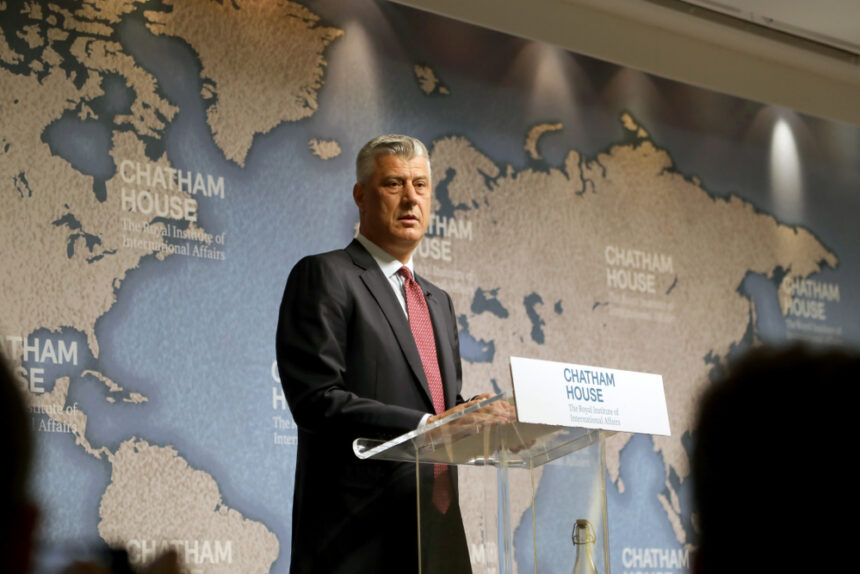
Former Kosovan President Hashim Thaci was found guilty of murdering 96 people and other war crimes and crimes against humanity by a panel of international judges in The Hague on Wednesday.
Judge Charles Smith III, a former Iowa judge and U.S. citizen, sentenced Thaci to 25 years in prison with credit for time served. Prosecutors had asked for the maximum sentence of 45 years.
Thaci, 58, led the KLA during the 1998-1999 war against Serbia and served as president of the country from 2016 to 2020, resigning when he was indicted.
The verdict
The guilty verdicts cover multiple counts connected to the armed campaign for independence from Serbia. Judge Smith found Thaci guilty of the illegal and arbitrary arrest and detention of 385 people, the cruel treatment of 49 people, the torture of 303 people and the murder of 96 people.
Three co-defendants, all former commanders in the independence movement, were also convicted. They are Kadri Veseli, Rexhep Selimi and Jakup Krasniqi. All four had denied all charges against them. Prosecutors had sought the 45-year maximum for all four defendants. The Sept. 16 hearing was livestreamed.
The Kosovo Specialist Chambers
The Kosovo Specialist Chambers is an international court created under the country’s own law but based in The Hague and staffed largely by international judges and prosecutors. It was established to address alleged crimes committed by the armed movement during and after the conflict, following years of pressure from Western governments that had largely supported the independence campaign.
The court’s jurisdiction covers crimes between Jan. 1, 1998, and Dec. 31, 2000. Wednesday’s verdicts are the most significant it has issued since it began operating.
The historical context
The war began as an armed insurgency against Serbian government forces and ended with NATO airstrikes against Yugoslavia in 1999. The country declared independence in 2008, recognized by more than 100 nations but not Serbia or Russia.
The KLA has been celebrated by many Kosovars as liberators. The convictions of senior commanders for crimes committed during that conflict create a complicated historical reckoning for a country whose national identity is closely tied to the independence struggle.
Thaci was a central figure in that history, both as a military commander and later as the country’s president. His 25-year sentence, with credit for time already served in pretrial detention, means he could serve fewer years in custody depending on applicable rules.