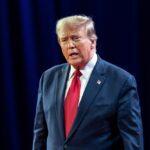
President Trump ordered the Pentagon to scale back joint military exercises with South Korea on Aug. 16, citing his personal relationship with North Korean leader Kim Jong Un and expressing frustration with what he characterized as the exercises’ cost and inappropriate signal to Pyongyang.
Trump posted on Truth Social that he was not happy with the fact that the United States had agreed to participate in the joint exercises with South Korea. He said the drills were costly, with much of the expense paid by the United States, and that they sent a signal he described as totally inappropriate and hostile toward a country that, he said, had been unthreatening and respectful throughout his presidency.
The president said he initially wanted to cancel the exercises entirely but was told it was too late to do so and instead directed Secretary of Defense Pete Hegseth to reduce their scope.
The drills had been scheduled to last 11 days and involve 18,000 South Korean soldiers, with activities including live-fire testing of joint precision targeting and maneuver, a wet gap crossing and distribution of military equipment.
South Korea’s Iran stance also cited
In the same post, Trump expressed frustration with South Korean President Lee Jae Myung for declining to support the United States during the conflict with Iran, which Trump said began on Feb. 28. He described asking South Korea whether it would join the United States in a denuclearization effort against Iran and said the South Korean government declined.
The linking of this decision to South Korea’s posture on Iran is notable because the two issues are formally separate. The joint drills have historically been justified on the basis of the North Korean threat and the U.S.-South Korea alliance obligation, while the Iran war is a distinct theater involving different strategic calculations.
The North Korea relationship
Trump posted an image of himself and Kim Jong Un from their June 2019 meeting at the demilitarized zone between North and South Korea the day before announcing the scaled-back exercises, captioning it with a note that despite the photo’s unfriendly appearance, the two get along very well.
During that 2019 meeting, Trump stepped onto the North Korean side of the demilitarized zone at Kim’s invitation, becoming the first sitting U.S. president to enter North Korea. Trump met Kim three times during his first term and has spoken favorably about their correspondence on multiple occasions.
The decision to scale back the drills while publicly invoking the Kim relationship reflects a long-standing tension in U.S. Korea policy. Military drills with South Korea are designed to maintain readiness against a potential North Korean threat, while diplomatic engagement with Pyongyang has typically included signals that such activities will be reduced or suspended.
The strategic implications
South Korea and the United States conduct joint military exercises as part of their mutual defense treaty, which has been in place since the Korean War. The joint drills are designed to ensure that the two militaries can operate together effectively in the event of a conflict on the peninsula. Critics argue that reducing readiness creates real vulnerabilities regardless of the current temperature of relations with Pyongyang.
Supporters of Trump‘s approach argue that the exercises provoke North Korea unnecessarily and that diplomatic engagement offers a more durable path to stability. Trump made the same calculation in his first term when he suspended exercises after his Singapore meeting with Kim in 2018.
South Korea had not publicly commented on the decision as of the time of this article.