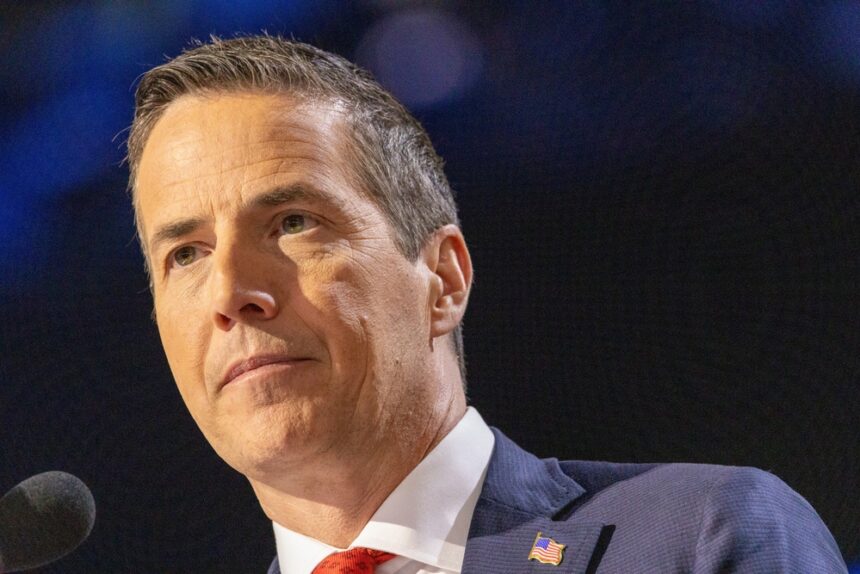
Sen. Bernie Moreno of Ohio has called on Treasury Secretary Scott Bessent to open a national security review into a Chinese solar company’s plans to lease or purchase a property roughly 13 miles from Wright-Patterson Air Force Base, one of the most strategically significant military installations in the country.
Moreno, who serves on the Senate Committee on Homeland Security and Governmental Affairs, sent the letter on July 31, targeting SolarSpace Technology, a China-based manufacturer of photovoltaic cells and modules. The company reportedly intends to acquire a facility at 2555 Woodman Drive in Kettering, Ohio, placing it within what Moreno described as an unacceptable proximity to a base that houses some of the Air Force’s most sensitive research and intelligence operations.
In his letter, Moreno argued that the Chinese Communist Party should not be permitted to lease or purchase land near American military installations, framing it as a national security concern that warranted scrutiny through the interagency body that reviews foreign transactions for potential security implications.
Why Wright-Patterson is strategically significant
Wright-Patterson Air Force Base is among the most mission-critical facilities in the American military system. It is home to the Air Force Materiel Command, which oversees the development and acquisition of Air Force weapons systems. It houses the Air Force Research Laboratory, one of the primary centers for military scientific research in the United States. And it contains the National Air and Space Intelligence Center, which produces intelligence assessments related to foreign aerospace capabilities.
Together, those three organizations employ more than 38,000 military personnel, civilians and contractors at the base, making it a substantial employer in the Dayton region and a focal point for some of the most sensitive Air Force work being conducted anywhere in the country.
The research laboratory’s history includes decades of hypersonic science and technology research dating to the early 1960s. A senior scientist at the facility noted in 2021 that the United States had invested roughly $1.7 billion in hypersonic research there over the preceding 25 years, an indication of how central the base has been to the development of one of the most contested technology domains in modern military competition between the United States and China.
The broader context of Chinese land purchases
The Moreno letter arrives amid a period of heightened congressional and executive branch attention to Chinese real estate acquisition patterns near American military installations. Several states have passed laws restricting or banning land purchases by Chinese nationals or companies, and the federal government has at various points blocked or unwound transactions it deemed to present security risks.
The specific concern is not simply about intelligence gathering. Critics of Chinese proximity to military bases argue that facilities near sensitive installations can be used to monitor communications, capture signals intelligence, observe flight patterns and logistics, or otherwise gather operational data valuable to a foreign military or intelligence service. The commercial framing of a transaction as a manufacturing facility does not eliminate those risks, which is precisely why the review process exists.
SolarSpace Technology has not publicly commented on the transaction or on the Moreno letter.
What a national security review would entail
The review Moreno requested would be conducted by the interagency committee that evaluates foreign investments for security implications. That body has the authority to recommend blocking a transaction or requiring mitigation measures as a condition of approval. The review process is confidential by statute, meaning that neither the outcome nor the specifics of the deliberation are typically made public.
Whether the transaction qualifies for mandatory review depends on the specific deal structure and applicable thresholds. The Moreno letter represents a congressional push to ensure the matter receives attention regardless of whether automatic review requirements apply.
The broader debate that Moreno invoked over Chinese solar manufacturers and their potential ties to the Chinese government and military has been a recurring theme in national security discussions. Photovoltaic manufacturing, while civilian in its primary application, relies on supply chains and manufacturing processes that overlap with some industrial and materials capabilities relevant to defense applications.