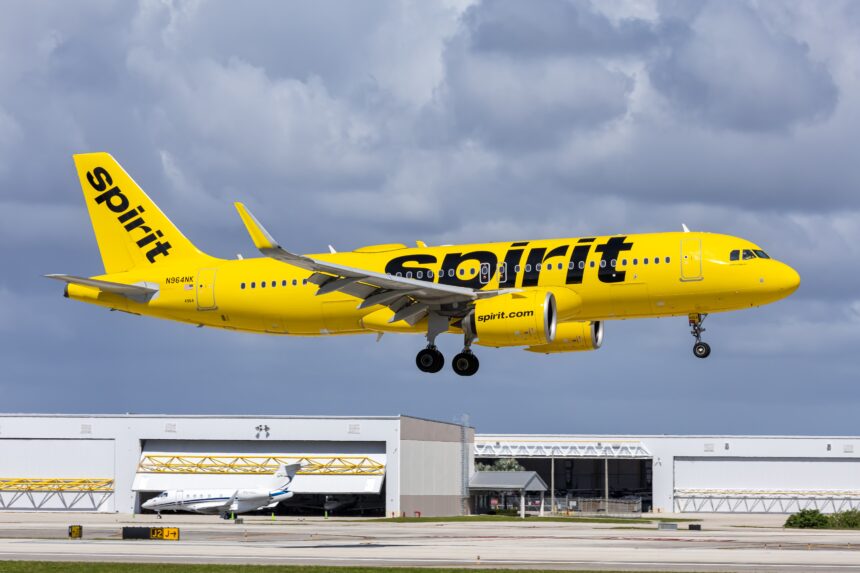
President Donald Trump said Friday that his administration is still actively weighing a taxpayer-funded takeover of Spirit Airlines keeping alive a proposal that has drawn sharp criticism from lawmakers on both sides of the aisle and raised broad questions about the appropriate use of public money.
Trump made the remarks to reporters as he prepared to depart the White House for a trip to Florida, offering few specifics but signaling that a formal announcement could come as soon as Friday or Saturday. He framed the potential deal as contingent on favorable terms, emphasizing that any agreement would need to benefit the federal government before moving forward.
The president cited job preservation as one of the central motivations behind the administration’s interest in the struggling carrier, noting that a final proposal had already been extended to the airline. He also drew a loose comparison between the potential Spirit deal and his administration’s earlier decision to make the U.S. government a major stockholder in Intel, the semiconductor manufacturer, while acknowledging that the two situations differ in meaningful ways.
A proposal weeks in the making
Trump first publicly floated the idea of a government-funded takeover of Spirit last week, suggesting at the time that the U.S. could eventually resell the airline for a profit once fuel costs pushed higher by the ongoing conflict with Iran come back down. That framing positioned the deal less as a traditional bailout and more as a strategic investment, though critics have been quick to challenge that characterization.
Around the same time, a lawyer representing Spirit told a U.S. Bankruptcy Court that the airline was in advanced discussions with the federal government on a financing arrangement that could allow it to exit Chapter 11 protection. Those talks appear to be ongoing, with no final agreement announced as of Friday afternoon.
Who’s for it and who’s against it
The proposal has found support among labor groups that represent Spirit’s pilots and flight attendants. Those organizations have argued that allowing the low-cost carrier to collapse entirely would cause significant harm to the airline’s workforce while also removing a budget-friendly option from a market where fares could climb if competition thins out.
Opposition has been louder and more bipartisan. Republican and Democratic lawmakers alike have raised red flags about committing public funds to a company with a long and troubled financial history. Several critics have questioned whether any amount of federal support could meaningfully turn around an airline that has spent years posting losses and has now filed for bankruptcy protection twice once in November 2024 and again in August 2025.
Spirit’s deepening financial trouble
Spirit’s situation has grown increasingly precarious in recent months. The carrier, widely recognized for its fleet of bright yellow planes and its reputation as one of the most aggressively low cost options in the domestic market, has been unable to find a stable path back to profitability.
The Iran conflict has made conditions even harder. As fuel prices climb across the airline industry, Spirit’s creditors last month began publicly expressing doubt about the company’s ability to continue operating at all. That raised a scenario that would have been difficult to imagine just a few years ago that Spirit could be forced to liquidate its assets entirely and cease flying altogether.
What comes next
For now, the proposal remains in limbo. Trump’s comments Friday confirmed that the administration has not walked away from the idea, but the lack of a finalized agreement leaves significant uncertainty for Spirit’s employees, creditors, passengers and the broader budget travel market.
Whether the deal ultimately moves forward may depend on the terms the administration is able to negotiate and whether those terms can survive the political scrutiny that is already building on Capitol Hill. With an announcement potentially coming within the next 24 to 48 hours, the fate of one of America’s most recognizable and most financially troubled airlines could soon become much clearer.
Spirit currently operates routes across the U.S., Latin America and the Caribbean, and its continued existence as a carrier remains in question pending the outcome of these federal discussions.