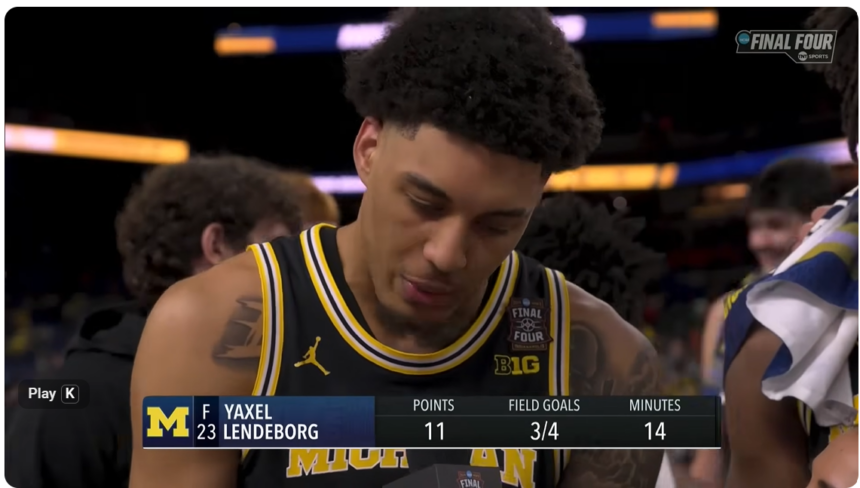
Yaxel Lendeborg left the floor in visible pain Saturday night with 8:51 remaining in the first half of Michigan’s Final Four game against Arizona. He came back out to start the second half with his knee wrapped, a slight limp and something to prove.
He swished two three-pointers in the span of 80 seconds. Michigan’s lead, already 16 at halftime, grew to 56-34. The Wolverines went on to win 91-73, advancing to Monday night’s national championship game against UConn. And Lendeborg made clear after the game that nothing short of an inability to walk would keep him off the floor.
The injury occurred when Lendeborg stepped on a defender’s foot while driving to the basket, re-aggravating a left ankle issue he had first sustained during the Big Ten Tournament and simultaneously hurting his left knee. He was assessed at halftime and returned, but played only 14 minutes total. He finished with 11 points, three rebounds and an impact that his teammates described as far larger than the box score reflected. He said he would undergo an MRI later Saturday night to determine the full extent of the damage, with an MCL sprain identified as the most likely diagnosis.
What Lendeborg did and how he did it
Returning for the second half after treatment in both a sideline medical tent and the locker room, Lendeborg made a deliberate decision to shoot from the perimeter rather than attack the basket. He understood his lateral movement was compromised and adjusted his game accordingly. The two three-pointers he converted effectively ended any remaining suspense in the game, extending a lead that Arizona had no realistic hope of overcoming.
His teammates noticed immediately. Guard Nimari Burnett described feeling a physical surge of adrenaline watching Lendeborg come back and contribute at a meaningful level despite the injury. Guard Trey McKenney said the moment reflected who Lendeborg is as a person and as a competitor, noting that the performance was both selfless and spectacular given the circumstances.
Coach Dusty May said Lendeborg’s willingness to be one of the group despite being the team’s best player has set a standard that makes everyone else easier to coach. He credited that attitude as a key factor in how the entire roster has approached the tournament.
What Lendeborg said about coming back
Lendeborg described the moments after the injury as among the most difficult he has experienced as a player. He acknowledged being frightened, having never dealt with a knee injury before, and said he spent time in the medical tent releasing frustration before finding a way to refocus. Once he learned Michigan still led by 16, his mindset shifted. He said he prayed and decided he was going back in regardless of what anyone else thought, including his mother and his representatives, who were not in favor of the decision.
His explanation for returning came down to something his mother taught him growing up, a simple principle about not letting pain become an excuse. He said there are people dealing with far worse circumstances, and that as long as he could run and jump, he was going to play.
What it means for Monday
Lendeborg averaged 25 points across Michigan’s previous three tournament wins before Saturday’s game. His presence against UConn, even at something less than full strength, represents a significant factor in how the championship plays out. The Wolverines are 1-7 all-time in national title games, and this year’s team has won its five tournament games by an average of more than 21 points.
Whether Lendeborg is fully healthy on Monday remains to be seen. What is not in question is whether he intends to be there.