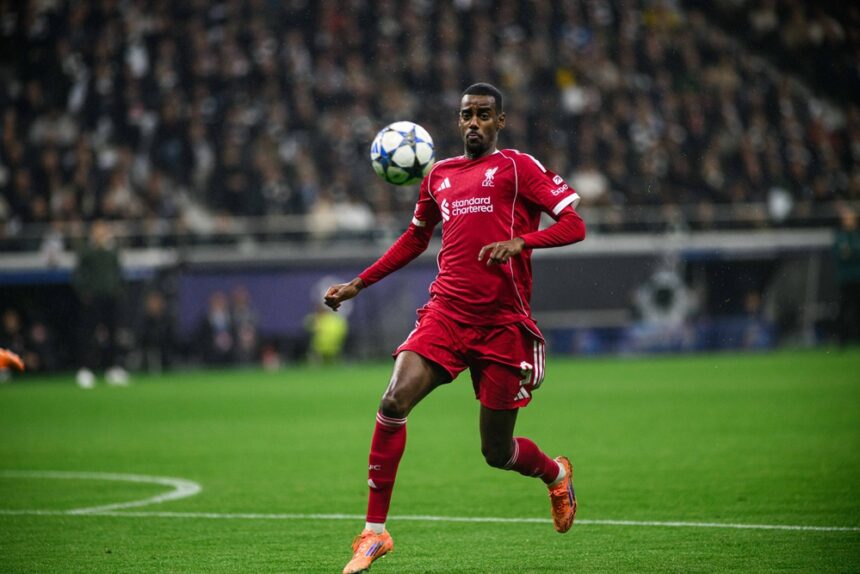
Alexander Isak returned to team training with Liverpool, ending an absence of more than three months that began with surgery following a serious injury in December. The 26-year-old Swedish striker has been working toward this moment since sustaining a broken ankle and fibula in a tackle during a December 20 fixture against Tottenham Hotspur.
For Liverpool, the timing carries weight. The club is deep into a critical stretch of the season, with a Champions League quarterfinal against Paris Saint-Germain on the horizon and an FA Cup match against Manchester City scheduled for April 4. Isak is not expected to feature in those immediate fixtures, but his presence in training changes the mood around a squad that has been managing his absence since before the new year.
What Slot said
Liverpool head coach Arne Slot addressed Isak’s return in comments to club media on Wednesday, framing it as genuinely valuable for a team that has continued to create chances even without its record signing. Slot acknowledged that Isak would not simply step into the starting lineup from his first session back, but said having him available for the final two months of the season would be meaningful for the group.
Slot also noted that Isak is in a strong place personally, with Sweden having clinched their spot in the summer’s World Cup just the night before. The Swedes secured qualification with a 3-2 victory over Poland in a European playoff final on Tuesday, one of the last nations to confirm their place in the tournament. The combination of personal milestone and professional return made Wednesday a notable moment for the striker.
A transfer that came with pressure
Isak joined Liverpool from Newcastle United on a British-record transfer fee of £125 million, a figure that immediately placed significant expectations on his shoulders. The move followed extended negotiations and represented one of the most expensive deals in the history of English football.
His debut season has been disrupted almost from the start. Seven months into his Liverpool career he has managed only two Premier League goals, a return that has prompted discussion about whether the club’s investment will be justified. Isak’s defenders point to the injury as the central explanation, arguing that the sample size of healthy appearances is too small to draw conclusions about his fit at the club.
The coming weeks will offer a more meaningful data set. With Mohamed Salah expected to leave at the end of the season, Liverpool’s attacking options for next year are already a subject of significant focus. How Isak performs in the remaining months could shape the club’s decisions about whether to pursue further reinforcements in the summer or trust their existing investment to carry more of the load.
Man United face a different reckoning
Elsewhere in European competition, Manchester United’s women’s team exited the Champions League quarterfinals on Wednesday after falling 5-3 on aggregate to Bayern Munich. United had gone into the second leg in Munich trailing after a 3-2 defeat in the first match at Old Trafford. They managed to level the aggregate score early in the second leg before Bayern scored twice in the final ten minutes to advance.
Manager Marc Skinner was candid after the match about what the result revealed. United were without eight players through injury, many the result of overuse, and had only four outfield substitutes available. Skinner acknowledged that competing consistently at this level requires the kind of squad depth and financial investment that United have not yet reached.
He pointed to the wage and spending gap between United and clubs like Arsenal and Chelsea as evidence of what the club still needs to address. United’s wage bill sat at roughly £5.88 million in the most recent accounts, compared to Arsenal’s £11.3 million. Their agent fee spending of £197,000 similarly lagged far behind Chelsea’s £1.08 million outlay.
Skinner framed the defeat not as a failure but as a lesson the club needed, describing it as the kind of outcome that forces clarity about what it actually takes to compete at the highest level of European football on a consistent basis. The club’s first full Champions League run ends here, but the manager’s message was that the experience should now drive serious decisions about investment and squad construction going forward.