Sunday was supposed to be different for the Cavaliers. Coming off consecutive wins and playing with the kind of confidence that makes a team dangerous, Cleveland arrived in Oklahoma City with something to prove. Instead, the Thunder handed them a reality check so sharp it left marks.
OKC 121. Cleveland 113. And it was not nearly as close as that final score suggests.
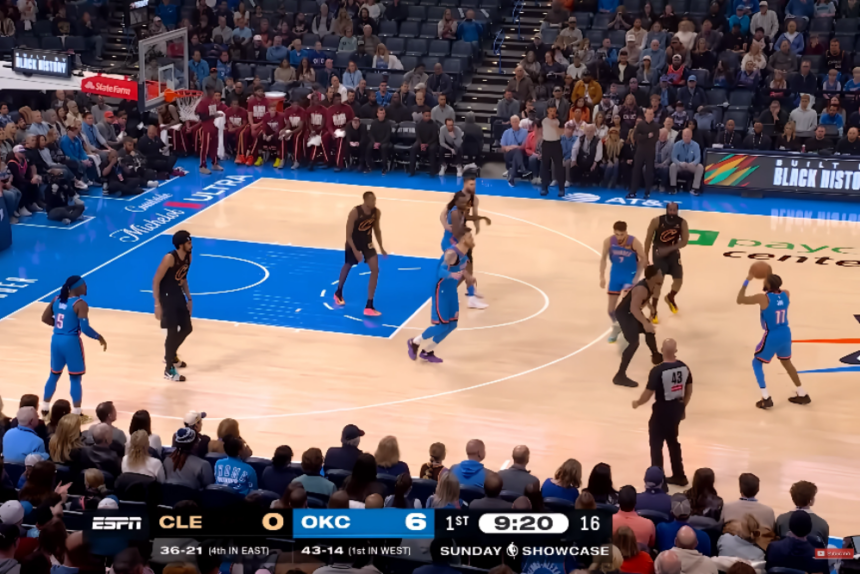
The Thunder wasted zero time setting the tone. Oklahoma City poured in 40 first-quarter points, a suffocating burst that put the Cavaliers in survival mode before the game even found its rhythm. Cleveland clawed back in the second and third quarters, but every time the Cavaliers inched closer, the Thunder had an answer. OKC’s advantage ballooned to 23 points at its peak — a number that captured the true nature of this beatdown far better than the final margin ever could.
How Oklahoma City Turned Threes Into a Weapon
The Thunder did not beat Cleveland with size or physicality alone. They beat them from distance, repeatedly and without mercy. Oklahoma City knocked down 21 three-pointers on 41 attempts — a scorching 51.2 percent — and the Cavaliers simply had no defensive system capable of stopping it.
Isaiah Joe came off the bench and turned in the kind of performance that makes opposing coaches lose sleep. Six three-pointers, 22 points, and five steals in a shift that flipped the game’s entire energy. Chet Holmgren was everywhere — 17 points and 15 rebounds, controlling the paint and making life miserable for Cleveland’s bigs. Isaiah Hartenstein did not miss a single field goal attempt, going a perfect 6-for-6 while adding 13 points and 7 boards.
The Thunder also feasted on Cleveland’s carelessness with the ball. Oklahoma City turned 17 Cavaliers turnovers into 31 points — a conversion rate that rendered Cleveland’s offensive efficiency almost meaningless.
Thunder Expose Mitchell and Cleveland’s Fragile Ceiling
Donovan Mitchell was not the problem. He was, in fact, the only reason this game stayed within single digits as long as it did. Mitchell finished with 20 points, 7 rebounds, and 5 assists, attacking the rim with urgency and refusing to let his team collapse entirely. But a 9-of-19 shooting night that included zero made threes told a quieter story — one about a superstar working overtime against a defense that had his number all afternoon.
James Harden contributed 20 points and 9 assists and looked engaged and dangerous in stretches. Dennis Schroder added 11 points and dished out 7 assists but picked up a technical foul that summed up Cleveland‘s collective frustration. Evan Mobley was efficient with 15 points, yet none of it added up to enough against a Thunder team operating with a different level of precision and purpose.
Cleveland’s bench actually outscored Oklahoma City’s reserves 47 to 37 — a silver lining buried under an avalanche of problems. Sam Merrill drained six threes and finished with 20 points in a sharp individual performance. But bench production only matters when the game is still winnable, and for large stretches on Sunday, it was not.
What Comes Next for a Wounded Cleveland
The Cavaliers have no time to sit with this one. The New York Knicks visit on Wednesday, followed by a road trip to Milwaukee — two tests that will demand an immediate response from a team that just had its confidence tested in the worst possible way.
Cleveland‘s talent is not in question. The roster is real, the pieces are legitimate, and the Cavaliers remain one of the East’s most dangerous teams on paper. But paper does not win games in Oklahoma City. And right now, the Thunder are proving that the gap between contending and dominating is wider than it looks — and that Donovan Mitchell, for all his brilliance, cannot close it alone.