The Frontier supercomputer found invisible surface roughness on turbine blades that’s been silently destroying fuel efficiency and engine life
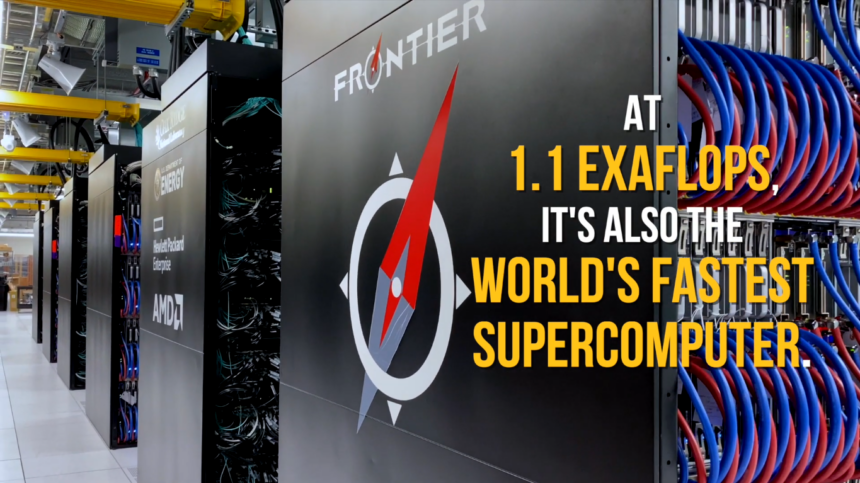
The Frontier supercomputer discovered something in January 2026 that humans had missed for decades: every jet engine flying right now has a hidden flaw. Located at Oak Ridge National Laboratory, the Frontier is the world’s first exascale supercomputer, capable of performing one quintillion calculations per second. That’s such an absurdly massive amount of computing power that it can detect problems that were literally impossible to spot before. And what it found is both fascinating and troubling: surface roughness on jet engine turbine blades that’s been quietly destroying fuel efficiency and shortening engine life for every commercial airline and military fighter plane in the skies.
- The Frontier supercomputer found invisible surface roughness on turbine blades that’s been silently destroying fuel efficiency and engine life
- This isn’t some manufacturer defect or quality control failure
- What makes this flaw so damaging is how insidious it is
- But here’s where it gets interesting: Frontier’s discovery is already being applied to fix the problem going forward
- The Frontier is doing way more than just studying jet engines
- The catch is that Frontier is an absolute power hog
This isn’t some manufacturer defect or quality control failure
The roughness Frontier discovered exists on turbine blades in both turbojet and turbofan engines because of the fundamental physics of how these engines operate. The imperfections are so microscopic and the physics of their impact so complex that no computational system before Frontier could have possibly detected them. This is literally a discovery that required the most powerful computer ever built to uncover.
What makes this flaw so damaging is how insidious it is
The surface roughness leads to a loss of fuel efficiency which means airlines are burning more fuel than they should be just to maintain normal performance. More fuel burn means higher emissions, higher costs, and a greater environmental impact. The roughness also generates more heat, which puts additional stress on the turbine blades themselves. Over time, that extra heat and stress shortens the operational life of the blades, which means more frequent maintenance, more replacement parts, and more downtime for aircraft. It’s a cascading problem that affects everything from operating costs to environmental impact.
But here’s where it gets interesting: Frontier’s discovery is already being applied to fix the problem going forward
Engineers now understand exactly what’s happening and can design future turbines to compensate for and overcome these flaws. They can’t eliminate all surface imperfections that’s basically impossible at the molecular level. But they can engineer turbines to handle those imperfections better. Additionally, cooling the turbine blades is going to become a much bigger focus in future designs, which should mitigate some of the heat-related damage that current imperfections cause.
The Frontier is doing way more than just studying jet engines
The supercomputer is part of the Department of Energy’s Innovative and Novel Computational Impact on Theory and Experiment (INCITE) program, which selected 81 other projects in 2025. These projects span cosmic ray transport, drug discovery using quantum-AI, and countless other fields where massive computing power is the only way to unlock insights. Frontier is basically opening doors in physics and machine learning that were previously locked.
The catch is that Frontier is an absolute power hog
The supercomputer consumes between 8 and 30 megawatts of electricity enough to power several thousand residential homes. All that processing generates tremendous amounts of heat that has to be managed through a complex cooling system. We’re talking about pumping 2,378 to just under 6,000 gallons of water per minute through a closed-loop design just to keep the machine from melting itself. And despite all that effort, a lot of the heat being generated basically can’t be reused or redirected efficiently, so it just gets wasted into the environment.
The real story here is about what happens when you build a machine smart enough to see problems that were invisible before. Frontier didn’t create the jet engine flaw it just revealed it. Every engine flying today has had this problem from day one. But now that we know about it, we can fix it in future designs. That’s the power of exascale computing: it doesn’t just solve problems faster than humans can. It reveals problems humans couldn’t perceive at all.