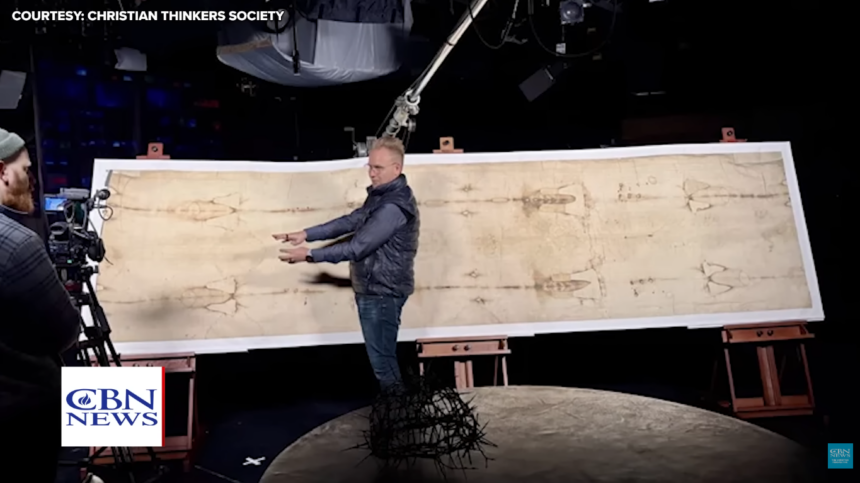
Using 3D modeling software, he showed that a real human face would look totally different pressed onto fabric than what we actually see
For centuries, believers have seen Jesus’s face in the Shroud of Turin. The cloth, which has been the subject of fascination and debate since the 14th century, supposedly bears the impression of a man matching the traditional depiction of Jesus Christ long hair, beard, the whole spiritual package. When viewed in photographic negative, the image becomes undeniable. There’s definitely a face there. The question has always been: how did it get there? A divine miracle? A natural impression from a dead body? Or something way more mundane? A Brazilian researcher just provided an answer that believers probably won’t love: it’s basically a medieval painting.
The Shroud of Turin has driven religious scholars absolutely crazy for centuries
Many believe it’s the actual cloth wrapped around Jesus after his crucifixion, and that his divine nature literally left an eternal impression on the fabric. That’s a compelling narrative. But even theologians like 16th-century French reformer John Calvin weren’t buying it. Calvin wrote mockingly in his Treatise on Relics: “How is it possible that those sacred historians, who carefully related all the miracles that took place at Christ’s death, should have omitted to mention one so remarkable as the likeness of the body of our Lord remaining on its wrapping sheet?” He had a point. If something that miraculous actually happened, wouldn’t someone have written about it?
Calvin went further, citing biblical reasons why this couldn’t have worked. Jesus was supposedly buried “according to the manner of the Jews,” which meant separate cloths for the body and head, not one unified sheet. Roman soldiers wouldn’t have let Jesus’s followers take such a sacred item. And nobody in the Bible mentions seeing this impression. Calvin basically concluded that either the Bible was lying or everyone claiming to have the Shroud was lying. He didn’t have a better explanation, though. Maybe he was too busy burning heretics to figure it out.
Now we have Cicero Moraes, a Brazilian 3D designer and researcher, who solved the problem using free software. Moraes tested a theory first proposed in the 1980s by researcher Walter McCrone: the Shroud isn’t actually an impression at all it’s a painting, possibly created using a low-relief sculpture rather than wrapping cloth around an actual three-dimensional body.
Here’s the genius of Moraes’s approach
if the Shroud really came from a cloth laid on or wrapped around a real human body, it would show specific distortions and flattening patterns that are scientifically predictable. Moraes created a 3D model in MakeHuman of a 33-year-old male, roughly six feet tall, thin basically matching the figure on the Shroud. Then he transferred it to Blender, a free open-source software, to refine the details.
What he discovered was revealing: when fabric is actually placed on a three-dimensional object, the impression it leaves gets warped and flattened in specific ways. Think about it like this: if you covered a globe with ink and wrapped fabric around it, when you unfolded the cloth, you wouldn’t see a perfect globe. You’d see a distorted, flattened version. But the Shroud of Turin doesn’t show those distortion patterns. It shows the kind of clean, undistorted image you’d get from painting on a flat surface or using a low-relief sculpture.
Moraes’s findings got published in the journal Archaeometry, which is basically peer-reviewed validation that his methodology was solid. His conclusion? The Shroud of Turin is almost certainly medieval art, not an authentic burial cloth impression. It’s well-crafted medieval art, sure. But art nonetheless. Which means centuries of religious devotion have been directed at what is essentially a very good forgery made by someone in the 1300s who knew exactly how to paint something that would blow people’s minds when viewed in photographic negative. That’s actually kind of impressive in its own way.