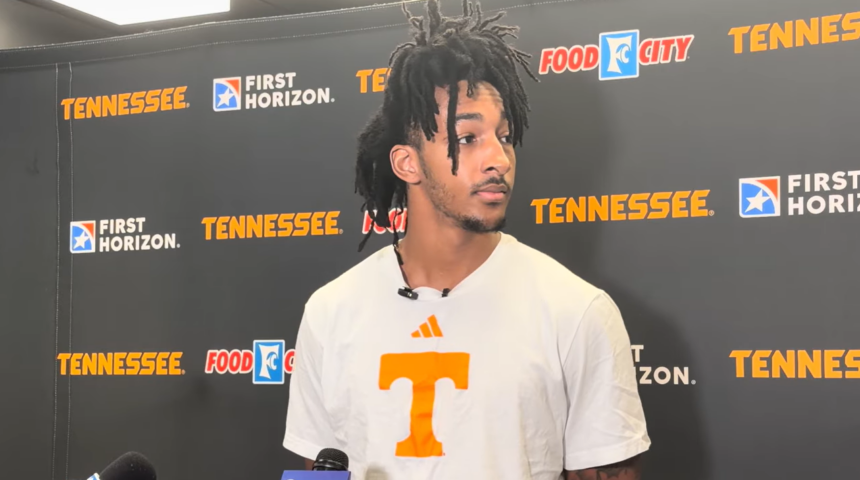
The 2027 NBA Draft class is drawing early attention for an unusual reason: experience. While the 2025 and 2026 classes leaned heavily on one and done freshmen fresh out of high school, the group forming for 2027 is stocked with battle tested upperclassmen who have spent multiple seasons sharpening their games. One name climbing draft boards is Juke Harris, a 6 foot 7 guard entering his junior season at the University of Tennessee.
A snapshot of the prospect
Harris checks in at 200 pounds and will be 21.9 years old at the time of the 2027 draft, giving evaluators a fuller body of work to study than they typically get with younger recruits. His size alone sets him apart. Standing 6 foot 7 in a backcourt role, Harris has the frame of a small forward paired with the ballhandling instincts of a guard, a combination that gives him rare positional flexibility.
Scoring from every level
Harris spent last season establishing himself as one of the most productive scorers in college basketball, averaging more than 21 points per game on efficient shooting. He connected on 44% of his overall field goal attempts and 33% from three point range, numbers that reflect an ability to score from all three levels of the floor. His touch inside was especially sharp, with a 59% conversion rate at the rim, while his mid range jumper landed at a solid 37%.
Flashes of playmaking potential
Though Harris built his reputation largely as a spot up shooter, he showed glimpses of becoming more than a stationary scorer. Operating as a pick and roll ball handler, he converted 36% of those possessions, a promising sign that he can create offense for himself rather than relying solely on teammates to set him up.
Rebounding from the backcourt
Perhaps the most underrated part of Harris’s game is his rebounding. Despite functioning as a guard, he pulled down 6.5 rebounds per game last season, with 5.3 coming on the defensive glass. For a scoring focused wing, that kind of production on the boards adds real value, giving coaches a player who impacts winning even when his shot isn’t falling.
Where he needs to grow
Harris’s game isn’t without questions. His three point shooting, while promising, needs to become more consistent. He attempted 7.5 shots from beyond the arc per game but connected on only 33% of them, a number NBA teams will want to see rise before fully trusting him as a floor spacer at the next level.
Defense remains the bigger concern. Harris’s offensive talent is not in doubt, but scouts will be watching closely to see whether he can develop into a reliable defender capable of holding up in NBA rotations. A more complete two way game could be the difference between a mid first round selection and a slide into the second round.
Looking ahead to draft night
Harris didn’t crack first round conversations during the loaded 2026 cycle, a class considered unusually deep at his position. But with the 2027 field shaping up to be thinner, he has a genuine opportunity to raise his stock. A strong junior campaign at Tennessee, particularly one that shows defensive growth, could push him into the mid to late first round.
What role he could play in the NBA
Evaluators see Harris settling into a role as a scoring guard at the next level, someone who provides instant offense while continuing to round out his defensive toolkit. His swing skill, the trait that will most shape his ceiling, is his defensive impact. If he can prove capable of guarding multiple positions, his blend of size, scoring and rebounding becomes an even more attractive package for teams searching for versatile backcourt talent.
For now, Harris remains a name to track as the 2027 draft picture continues to take shape at Tennessee.