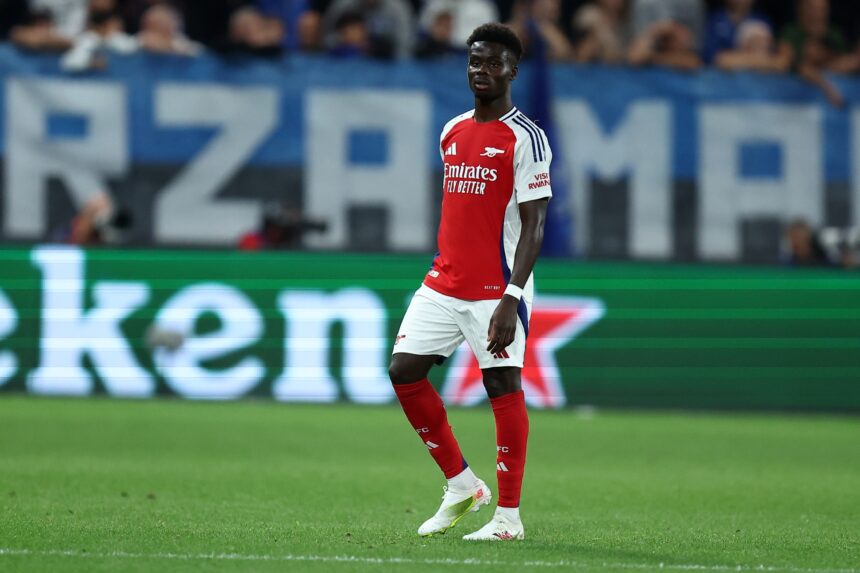
Bukayo Saka marked his return to Arsenal’s starting lineup by assisting the opening goal and adding one of his own before halftime against Fulham, then watched the second half from the bench as Mikel Arteta managed his workload ahead of a decisive Champions League semifinal.
Arsenal won the match 3-0. Saka assisted Viktor Gyökeres for the first goal, then scored himself with a precise finish just before the break. Arteta substituted him at halftime, a decision framed not as a concern about his condition but as a deliberate approach to building his minutes back up before the European tie.
The semifinal against Atlético Madrid is level at 1-1 after the first leg, with the second leg approaching. Having Him available and fit for that match has been Arsenal’s priority since he suffered the injury that kept him out of 10 games.
How Arteta is handling Saka’s return
Arteta acknowledged after the Fulham match that managing Saka’s return requires patience. The coach noted that Saka had played around 30 minutes in the first leg in Madrid and followed that with 45 against Fulham, describing the approach as a gradual increase in load while being careful not to risk him before the tie is decided.
The framing is straightforward. Saka is not fully match-fit by the standards of a player who has been playing continuously, but he is close enough to be impactful. The coaching staff is threading a needle between giving him enough game time to find his rhythm and not overloading him in a fixture that, at 3-0, did not require his presence in the second half.
Arteta described Saka as fresh and motivated, which matters as much as physical condition in a knockout match at this stage of the season.
Arsenal’s forward line without Saka
Saka’s absence across those 10 matches exposed how much Arsenal’s attacking output depends on him. The players who filled in during that stretch produced limited returns. Noni Madueke, who took on a prominent role in Saka’s absence, has not scored or assisted since February 12 against Brentford. Gabriel Martinelli’s last goal against top-flight opposition came on January 28 against Kairat. Leandro Trossard has not scored against a top-flight side since December 30 against Aston Villa.
Those numbers reflect a forward line that has struggled to generate consistent output without its most reliable contributor. It is part of why Saka’s 45 minutes against Fulham, even though they came in a comfortable win, carried a weight beyond the scoreline.
The injury picture ahead of the second leg
Saka’s return does not resolve all of Arsenal’s fitness concerns. Martin Ødegaard missed the Fulham match with knee discomfort and his availability for the second leg against Atlético is uncertain. Kai Havertz is also a doubt after picking up a muscular issue, and questions remain around Jurriën Timber’s readiness.
Arteta is managing a situation where his best players are returning or recovering at different rates, and the margin for error in a 1-1 aggregate tie is narrow. Atlético Madrid defend well and score in tight games, which means Arsenal will need contributions from across the squad rather than relying on Saka alone to carry the attacking load.
The Fulham result, and the way he moved through it, provides enough evidence that he can be a factor in the second leg. Whether he starts, comes off the bench or plays through another controlled stint will be among the more watched team news developments in the days before the match.
Arsenal are in the position they wanted to be in heading into the decisive leg of their most important European tie in years. Getting Saka back, fit and scoring, even in limited minutes, is the development that shifts the calculus in their favor.