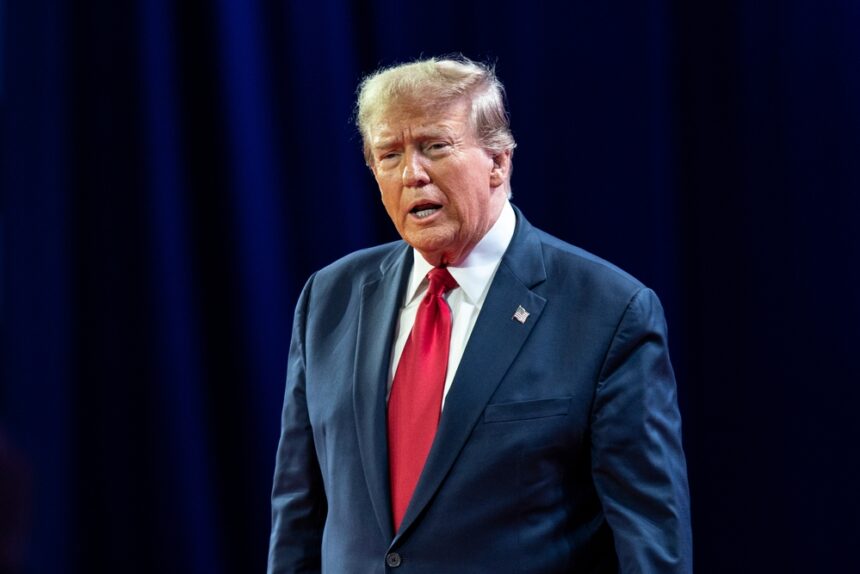
Donald Trump is ending a 15-year absence from the White House Correspondents Association dinner later this month, a decision that has taken on a complicated new dimension in the days since he announced it.
The annual press event, set for April 25 at the Washington Hilton, will honor a team of journalists whose reporting on Trump directly prompted him to file a billion-dollar lawsuit. That lawsuit was dismissed by a federal judge the same week the award was announced, setting the stage for what may be one of the more unusual evenings in the dinner’s long history.
The story behind the award
The journalism being recognized centers on a letter that reportedly surfaced connecting Trump to convicted sex offender Jeffrey Epstein. The letter, shaped to outline a female figure and written as an imagined dialogue between the two men, ends with a line wishing the recipient well and referencing a shared secret. A signature attributed to Trump appears at the bottom.
Trump denied authoring the letter and disputed the story entirely. The day after it was published, he filed a defamation lawsuit against the newspaper, its reporters and its parent company, seeking damages of ten billion dollars. On Monday, a federal judge dismissed the case, finding that Trump had come nowhere close to demonstrating the legal standard required to prove defamation by a public figure. The newspaper’s parent company released a statement affirming its confidence in the accuracy and rigor of its reporting.
Trump announced on his social media platform that his legal team intends to refile the case on or before April 27, two days after the dinner.
A return with complicated optics
Trump last attended the correspondents dinner in 2011, when he was a private citizen and then-President Barack Obama delivered remarks that drew considerable attention at his expense. He skipped the event throughout both of his presidencies until this year, when he accepted the invitation and framed his attendance as a gesture tied to the country’s 250th anniversary. His statement suggested he viewed the decision as a reflection of his standing among correspondents.
The dinner’s program will now include a formal presentation of the Katherine Graham Award for Courage and Accountability to the journalists behind the Epstein story, along with a ten-thousand-dollar prize. The honor is among the most prominent the association bestows. Protocol at the event typically calls for the sitting president to shake the hands of award recipients.
Whether Trump will follow that tradition given the circumstances is an open question. The White House had not addressed the matter as of Monday.
A night with more than one headline
The correspondents dinner will also recognize a photographer whose work captured a widely circulated image of Trump standing in the Oval Office while staff attended to a man who had fainted nearby. That photograph, taken in November, is being honored with the association’s Award for Excellence in Presidential News Coverage by Visual Journalists.
The juxtaposition of Trump’s return to an event he long avoided with an evening that includes recognition of reporting he went to court to suppress and photography that generated significant commentary about his conduct is not lost on observers. The dinner has a long history of producing uncomfortable moments for sitting presidents, but the circumstances surrounding this particular evening are unusually layered.
Trump and Epstein had a well-documented friendship that dated back years. Trump described Epstein publicly in 2002 as a terrific companion who shared his appreciation for women. Their relationship reportedly deteriorated in the years that followed. Epstein was arrested for sex trafficking minors and died in federal custody in 2019.
The April 25 dinner will mark Trump’s first appearance at the event as a sitting president.