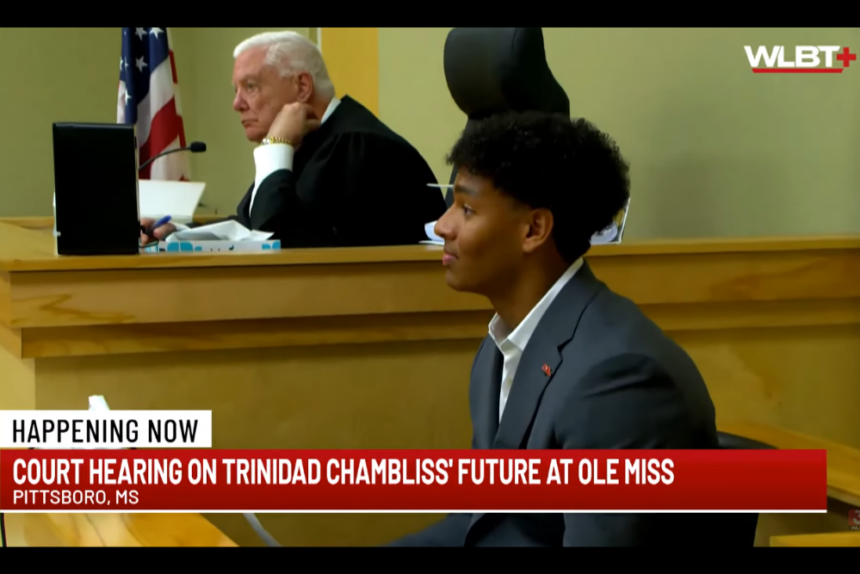
A Mississippi courtroom became the latest battleground between college athletes and the NCAA on Thursday as Trinidad Chambliss fought for his right to play one more season. The Ole Miss quarterback sued the organization in January after officials denied his request for a sixth year of eligibility despite documented medical complications spanning nearly a decade.
Judge Robert Whitwell presided over the hearing at Calhoun County Courthouse in Pittsboro, promising a decision by afternoon. The outcome will determine whether Chambliss can return to Oxford for the 2026 season or if his college career ends after a breakout campaign that led the Rebels to their first College Football Playoff appearance.
The case represents more than one player’s eligibility. It highlights fundamental tensions between athletes seeking control over their careers and an organization with absolute power to grant or deny those opportunities based on standards many consider arbitrary and inconsistent.
Medical Documentation vs NCAA Denial
Chambliss transferred to Ole Miss before the 2025 season after playing at Ferris State. His legal team presented extensive medical records showing health challenges dating back to 2017, when exposure to the Epstein-Barr virus led to mononucleosis. Respiratory issues, chronic tonsil infections, and sleep apnea kept him off the field or severely limited his performance for years.
Oxford ear, nose, and throat specialist Bradford Dye testified that Chambliss suffered from grade three tonsil enlargement, restricting 60 to 70 percent of his airflow. The condition caused extreme fatigue, shortness of breath, and recovery times that stretched three to four days for minor illnesses that typically resolve overnight in healthy individuals.
Chambliss sat out the 2022 season at Ferris State under medical redshirt after coaches observed his declining physical condition. He described feeling constantly exhausted, unable to complete workouts, and looking visibly smaller in team photos from that period. His mother Cheryl testified about serving as his walking pharmacy, administering various medications while watching her son struggle with symptoms that included dangerously loud snoring and apparent breathing cessation during sleep.
Despite this documented history, the NCAA appeals committee rejected his medical hardship claim. His attorneys argue the decision constitutes bad faith under Mississippi law, calling it unreasonable and arbitrary given the overwhelming evidence presented.
What Chambliss Stands to Lose
The financial implications extend beyond football. Chambliss testified he cannot sign revenue sharing agreements with Ole Miss while ineligible. His existing relationship with AT&T, which featured him in commercials during the fall, remains in limbo. Conversations with other companies wait on the court decision.
His legal team argues he faces irreparable financial harm without the additional year. Professional prospects factor heavily into the calculation. While Chambliss threw for 3,937 yards with 22 touchdowns against just three interceptions in 2025, adding 527 rushing yards and eight scores on the ground, NFL teams typically prefer quarterbacks with multiple successful seasons at the highest level of competition.
Ole Miss quarterbacks coach Joe Judge testified as an expert witness, explaining how NFL draft boards get constructed. Teams eliminate prospects quickly because the initial pool contains too many names. Judge said that only Cam Newton among Super Bowl starting quarterbacks played just one season as a Division I starter before entering the draft, emphasizing how rare such rapid ascension proves.
Another strong season could dramatically improve Chambliss positioning. Conversely, entering the 2026 draft after a single breakout year presents significant risk, especially for a player who competed at the FCS level before transferring.
The Broader Pattern of Control
The hearing exposed uncomfortable realities about how college athletics operates. NCAA attorney Taylor Askew argued during closing statements that granting the injunction would establish precedent for countless similar lawsuits, suggesting the organization views athlete agency itself as threatening.
This framing reveals the core issue. The NCAA maintains absolute discretion over eligibility decisions that can destroy careers and cost athletes millions in potential earnings. When Chambliss demonstrated he belonged at the highest level by leading his team to the playoff semifinals, the organization responded by denying him the opportunity to continue despite legitimate medical documentation supporting his claim.
Judge cross-examination by NCAA lawyers focused on whether Chambliss participated in any team activities during 2022, attempting to undermine medical hardship arguments by suggesting partial participation negates incapacitation. This logic ignores the reality that athletes often push through serious health issues under pressure from coaches, teammates, and their own competitive nature.
The case also highlighted tensions between different standards. While Chambliss clearly suffered documented health problems that affected his ability to compete, the NCAA apparently requires complete incapacitation to justify additional eligibility. This narrow interpretation leaves athletes who gutted through serious illness without recourse.
A Decision with Lasting Impact
Chambliss described his health journey on the witness stand, detailing the roller coaster of sickness and brief recovery periods, the constant fatigue, and feeling unable to breathe properly until his tonsil removal surgery in 2024. He stated he never felt fully healthy until after that procedure, making his 2025 performance even more remarkable.
His attorneys framed the request as entirely reasonable given the circumstances. The NCAA countered that any athlete could claim they would benefit from an extra season, so preventing such returns protects competitive balance. This argument treats all situations as identical regardless of individual circumstances, exactly the kind of one-size-fits-all approach that athletes increasingly challenge.
The hearing concluded at 3:01 PM without an immediate ruling. Judge Whitwell retired to chambers, reiterating his commitment to deliver a decision before day’s end. Whatever he decides will reverberate beyond Oxford, Mississippi. Athletes watching the case understand their own futures may depend on similar battles against an organization that views their success as something to be managed and controlled rather than supported and celebrated.
Trinidad Chambliss earned his opportunity on the field. Now a judge must decide whether the NCAA can arbitrarily take that opportunity away despite evidence supporting his right to continue playing.