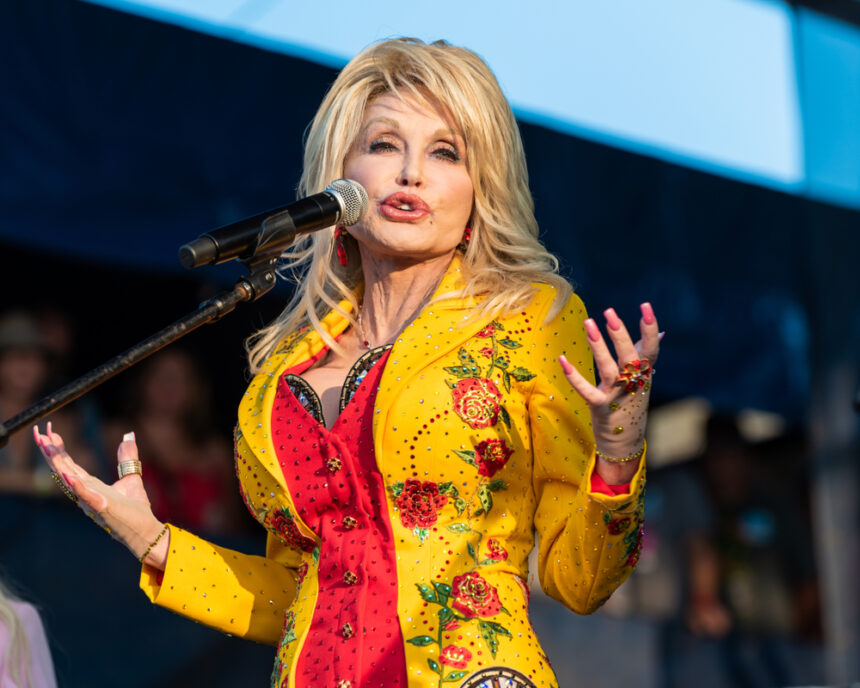
Dolly Parton, the singer-songwriter, actress, philanthropist and businesswoman who placed 113 songs on Billboard’s Hot Country Songs chart and recorded 25 No. 1 hits, the most by any female artist in country music history, died on Aug. 25. She was 80.
News of her death brought tributes from across American public life. President Trump posted on Truth Social that her passing represents a true loss for millions of people and that there has never been anyone like her and never will.
Flags were flown at half-staff as word spread.
A career that shaped country music
Parton rose to fame in the 1960s as one of the most prolific female singer-songwriters of her generation, emerging from the east Tennessee mountains with a voice and a sensibility that felt both rooted in tradition and entirely singular. Her early years as part of the Porter Wagoner Show established her nationally, and a series of No. 1 hits through the 1970s made her among the most successful recording artists of any genre.
Her songs became standards of American popular music far beyond country radio. Her 1974 recording of Jolene introduced a plaintive vocal style that would be covered and reinterpreted by artists across generations. I Will Always Love You, a song she wrote and recorded in 1973, became a standard of the form before Whitney Houston’s 1992 version transformed it into one of the best-selling singles in music history. Parton wrote both.
Beyond the music
Parton’s legacy extended well beyond her recording career. Parton founded the Imagination Library in 1995, a book-gifting program based in her home county in Tennessee that grew into an international initiative providing millions of free books to children from birth through the start of kindergarten. The program has distributed more than 300 million books in multiple countries.
She was known for her humor, her self-deprecating wit and her genuine engagement with the communities she had grown up in. When her statue was proposed for the Tennessee state capitol, she asked that it not be built, saying she did not believe she deserved to be put on a pedestal.
She received the Presidential Medal of Freedom and the Companion of Honor from the United Kingdom among her many awards and honors.
The culture she represented
Parton was a figure who managed to be universally beloved across political, regional and generational lines without having compromised what she believed or who she was. She spoke openly about her faith, her roots and her values without using them as a weapon. She was as comfortable on Sesame Street as she was on the Grand Ole Opry stage.
Her voice, her look and her personality became so fully identified with American popular culture that she occupied a category largely by herself. At 5 feet tall, she had described herself as a little thing but never a small one.
She is survived by her husband, Carl Thomas Dean, to whom she had been married since 1966, and members of her extended family.