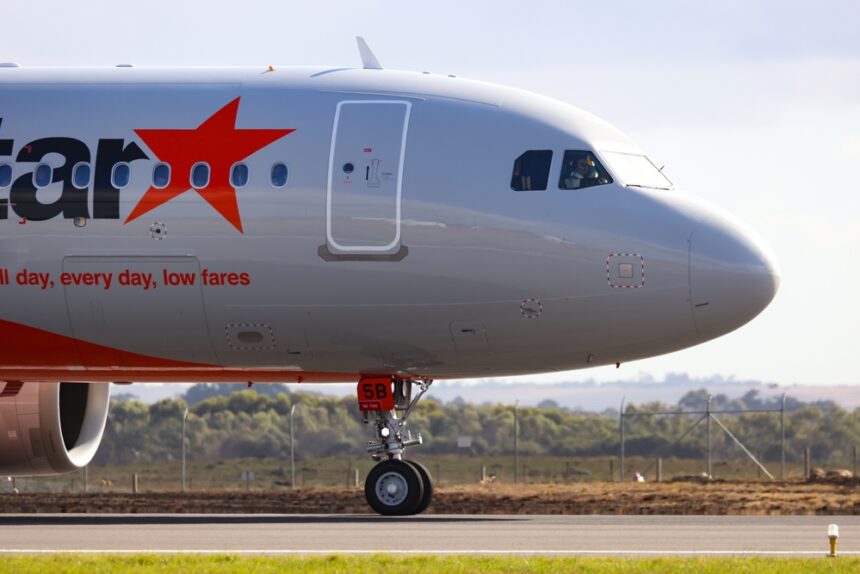
Jetstar will scrap its seven-kilogram carry-on baggage weight limit beginning February 2027, switching to a size-based system that the Qantas-owned budget airline says will simplify boarding and reduce friction for travelers.
The change takes effect on Feb. 2, 2027. Under the new policy, carry-on bags will need to fit within dimensions of 40 by 30 by 20 centimetres rather than meeting a weight requirement. Passengers whose bags exceed those measurements will either pay an excess carry-on fee and check the bag in, or purchase an additional baggage allowance at the boarding gate.
Jetstar’s chief executive acknowledged that weighing bags at the airport has created a frustrating experience for both customers and crew, and framed the shift as a move toward the size-based model already used by leading budget carriers overseas.
Despite removing the weight limit, Jetstar will maintain size restrictions for smaller under-seat items such as handbags, laptop bags and compact backpacks. Fees will apply to passengers whose under-seat bags exceed those limits.
How the current system works and why it causes friction
Under the existing policy, Jetstar staff weigh carry-on bags at the airport and charge a flat fee at the gate for those that exceed seven kilograms. The fee currently ranges between $60 and $85 in Australian dollars, equivalent to roughly $42 to $59 in U.S. dollars. The process of weighing bags at boarding creates queues and confrontations that the airline has apparently decided are not worth the revenue they generate relative to the operational cost and customer goodwill lost.
Weight-based carry-on limits have been a distinguishing feature of some low-cost carriers for years, creating an enforcement challenge that airlines increasingly find difficult to justify. Travelers who understand the rules often pack to exactly seven kilograms, then add heavy items to jackets and personal items before the weigh-in, undermining the revenue model the restriction was designed to protect. Airlines that have made this shift tend to report smoother boarding processes and fewer disputes at the gate.
The broader trend in airline baggage policy
The size-based approach that Jetstar is adopting has become more common among budget carriers globally. Airlines in Europe and North America that operate under similar low-cost models have largely moved away from weight-based carry-on restrictions in favor of dimensional limits that are easier to enforce consistently and less likely to generate customer complaints.
The move also reflects a broader shift in how budget carriers think about ancillary revenue. Carry-on weight enforcement has historically been one of the more unpopular fee mechanisms, and the goodwill cost of enforcing it aggressively may now outweigh the incremental revenue it generates. By shifting to size limits, Jetstar creates a cleaner and more predictable framework for passengers while maintaining the fee structure for those who try to bring oversized bags aboard.
Australian aviation has been competitive in recent years, with travelers more sensitive than usual to airline fees and service quality. The Jetstar move may also be partly responsive to competitive pressure from airlines that already use size-based systems and can market themselves as having simpler, less punitive baggage rules.
What it means for passengers
For most travelers, the change will be straightforward. A bag that fits within 40 by 30 by 20 centimetres will be permitted in the cabin regardless of how much it weighs. Passengers who travel with dense or heavy items that currently run them afoul of the weight limit but fit easily in the overhead compartment will no longer face a charge.
Those traveling with small under-seat items will still need to comply with size requirements for those bags, though the airline has not specified exact dimensions for that category in publicly available details at this stage.
The Jetstar change also creates a more predictable pre-travel experience. Travelers packing at home can focus on fitting belongings into the right dimensions rather than monitoring weight on a scale, which many find more intuitive and less stressful.
Jetstar serves domestic Australian routes and international destinations across Asia and the Pacific, and the Jetstar network change applies from February 2027.