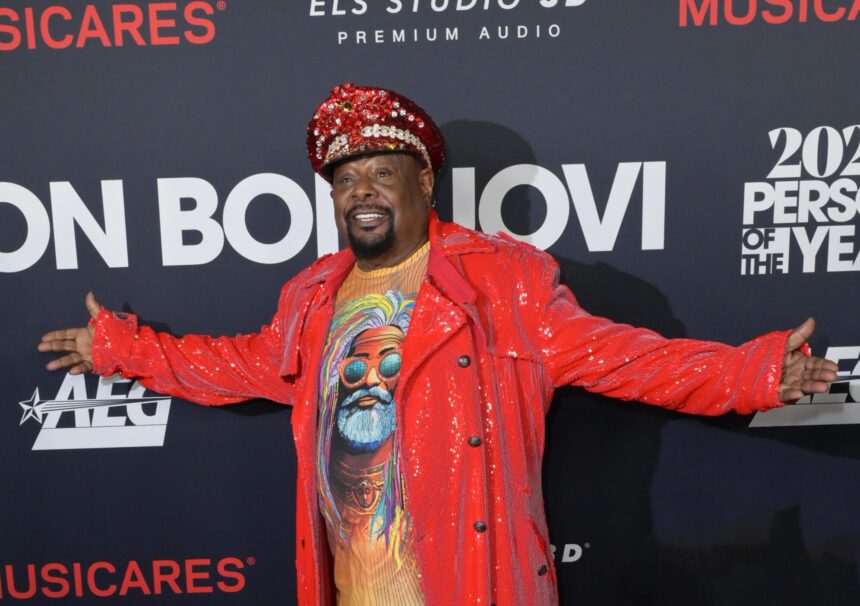
When George Clinton speaks about music, people tend to listen. At 84, the founder of Parliament and Funkadelic has seen every era of American popular music up close, which makes his recent assessment of Kendrick Lamar all the more striking.
Clinton was among the voices gathered by the New York Times Magazine for a feature spotlighting the 30 greatest living American songwriters. Asked to speak to Lamar’s place in that conversation, Clinton did not hesitate. He placed the Compton rapper in a category alongside Motown, Sly Stone, and the Beatles, describing that kind of cultural institution as something built to last far beyond any single moment or chart position. For Clinton, what separates Lamar from the crowded field of skilled lyricists working today is something harder to manufacture than technical ability. He called it soul.
George Clinton on what makes Kendrick Lamar different
Clinton did not stop at the compliment. He went further, reaching for an unexpected comparison to describe the effect Lamar’s music has on listeners. He likened the rapper to a psychiatrist, someone willing to examine and articulate the things that most people instinctively avoid. The observation pointed to Lamar’s ability to discuss difficult, uncomfortable, and often taboo subjects in a way that feels completely natural rather than provocative.
Clinton noted that when he first met Lamar, the younger man carried a weight and maturity that felt well beyond his years. That quality, he suggested, is what allows Lamar to shift conversations rather than simply participate in them. The topics he addresses are ones that rarely get named directly in popular music, yet Lamar handles them with a matter-of-fact confidence that makes the listener forget the subject was ever considered off-limits.
George Clinton and the test of generational relevance
One of the harder things for any artist to achieve, Clinton observed, is the ability to remain meaningful to audiences who never grew up with them. Younger listeners are notoriously loyal to their own generation’s voices. Crossing that divide and earning the attention of the generation that follows is something most artists never manage. Clinton pointed to Lamar’s ability to do exactly that as evidence of something rare and enduring.
The observation carries particular weight coming from someone who has watched countless artists peak and fade over more than five decades in the music business.
George Clinton and the album that changed everything
Clinton reserved his most pointed praise for To Pimp a Butterfly, Lamar’s landmark 2015 release and Grammy winner for Best Rap Album. He described the project as feeling like a single continuous piece of music rather than a collection of individual tracks, drawing a direct comparison to Marvin Gaye’s What’s Going On, widely regarded as one of the most cohesive and important albums in American music history. The comparison is not a casual one.
Clinton and Lamar share a history that predates the praise. The two collaborated on the opening track of that very album, and later appeared together on a Funkadelic remix single. The relationship gives Clinton’s admiration a personal texture that makes it feel less like an endorsement and more like a genuine artistic kinship.
George Clinton watches Kendrick Lamar make history
Lamar’s cultural standing has only grown since that collaboration. Earlier this year he became the most decorated rapper in Grammy history, surpassing a long-standing record with his 27th win. The milestone came alongside additional recognition for his recent work, capping a run that has placed him firmly among the defining artists of his generation.