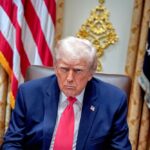
President signals military option remains viable while claiming previous B-2 strikes eliminated Iranian nuclear threat, now negotiating with Tehran
President Donald Trump has issued a direct warning to Iran’s supreme leader. In a new NBC News interview, Trump told host Tom Llamas that Ayatollah Ali Khamenei should be “very worried” about the state of Iran’s nuclear program as the United States pursues active negotiations with Tehran. The message combines diplomatic engagement with explicit military warning a strategy Trump says is essential to achieving lasting peace in the Middle East.
“I want peace in the Middle East,” Trump said in the February 4 interview. “If we didn’t take out that nuclear [program], we wouldn’t have peace in the Middle East.” When directly asked whether Khamenei should be concerned about current US intentions, Trump was unequivocal: “He should be very worried,” adding that negotiations are actively underway between the two nations.
The warning represents Trump’s approach to the Iran nuclear question: combining acknowledgment of ongoing diplomatic talks with explicit reminder that military options remain on the table. Trump framed Iran’s nuclear ambitions as the fundamental obstacle to regional stability, positioning the nuclear question as prerequisite to any broader peace initiative in the Middle East.
The Military Record
Trump’s confidence in the warning stems partly from what he characterizes as the success of previous military operations. Last year, the United States military and Israel launched air strikes on Iran’s nuclear facilities during a 12-day aerial conflict that saw Iran fire missiles and drones at both Israeli and American assets in the region. Trump described the operation in stark terms.
“Those beautiful B-2 bombers went in and they hit their target … and obliterated it,” Trump said, referring to the stealth aircraft and their impact on Iranian nuclear infrastructure. The B-2 Spirit bombers, among the most advanced military platforms in existence, can evade sophisticated anti-aircraft defenses through their stealth capabilities a technological advantage Trump emphasized when describing the strikes’ effectiveness.
Trump went further in assessing the stakes at the time of the strikes. He claimed that without American intervention, Iran would have produced a functional nuclear weapon within one month of the operation. That timeline underscores why Trump views the nuclear question as non-negotiable and why he’s willing to repeatedly invoke military action as a deterrent.
The Negotiation Signal
The warning to Khamenei occurs alongside active US-Iran negotiations over the nuclear program. This dual approach simultaneous diplomatic engagement and military threat represents Trump’s stated strategy for achieving his stated goal of Middle East peace. The negotiating position appears designed to pressure Iran into accepting limitations on its nuclear capabilities while the military option serves as enforcement mechanism.
he made it clear what he views as the consequence of Iranian non-compliance. If the regime attempts to restart its nuclear program, he warned that he would send bombers “right back” to strike Iranian nuclear facilities. The message is unambiguous: the window for negotiations exists, but compliance is the expected outcome.
The Regional Stakes
Trump frames the nuclear question as central to broader Middle East stability. In his telling, Iranian nuclear weapons development directly prevents the peace he says he’s seeking across the region. This positioning makes the nuclear issue non-negotiable in his mind not merely a technical arms control matter but fundamental to regional security architecture.
The reference to wanting “peace in the Middle East” echoes Trump’s first-term messaging on Middle East strategy, though his approach has evolved to emphasize the nuclear dimension more explicitly. For him, eliminating Iranian nuclear weapons capability is presented as prerequisite to any broader peace agreements or normalization efforts in the region.
The Path Forward
The interview signals that Trump intends to maintain pressure on Iran while keeping diplomatic channels open. The negotiation framework appears designed to test Iranian willingness to accept strict nuclear limitations while the military warning serves notice that the previous year’s strikes represent the potential future if negotiations fail.
Whether the combination of diplomatic engagement and military warning produces Iranian compliance or further escalation remains to be seen. But his message to Khamenei is clear: the nuclear program must be addressed, negotiations offer a path forward, and military options remain viable if diplomacy fails.