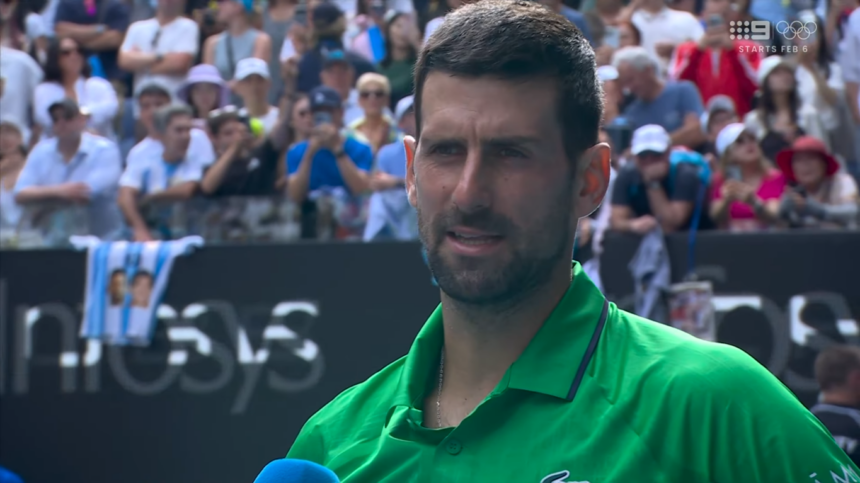
38-year-old admits he was “on his way home” as Musetti’s injury ends dominant performance up two sets
Novak Djokovic will never say he earned this win. The 38-year-old veteran walked off the court Wednesday knowing full well that he got incredibly lucky. He was down two sets to Lorenzo Musetti, dealing with a serious blister on his right foot, playing poorly, and already mentally packing his bags. Then Musetti’s right leg gave out, and Djokovic got a second life he didn’t deserve.
Musetti had to retire while leading 6-4, 6-3, 1-3. The 23-year-old Italian was playing the tennis of his life. He was controlling the match, dictating rallies, and making Djokovic look mortal. The 24-time major winner was struggling. He took a medical timeout after the second set for a serious blister on his right foot. He wasn’t moving well. He wasn’t feeling the ball. He was, by his own admission, on his way home.
But then Musetti felt something strange in his right leg. He tried to keep playing. He tried to push through. He managed almost two more games before the pain became unbearable and he had to walk to the net, remove his headband, shake Djokovic’s hand, and retire from a match he was winning convincingly.
That’s not how you want to advance. That’s not how a champion wants to reach a semifinal. Djokovic knows this better than anyone. He’s been on both sides of this scenario winning matches he didn’t earn, and losing matches he had in hand because his body betrayed him. But on Wednesday, he was the beneficiary of Musetti’s misfortune, and he had the grace to acknowledge it.
“I don’t know what to say except that I feel really sorry for him,” Djokovic said in his on-court interview. “He was the far better player. I was on my way home tonight.” That’s not false humility. That’s a player being honest about what just happened. Musetti was better. Musetti was winning. Musetti deserved to advance.
When playing your best isn’t enough
Here’s what makes Musetti’s retirement so cruel: he was performing at an elite level. Up two sets. In control of rallies. Setting the tempo. Making Djokovic uncomfortable. This wasn’t a match where Musetti was hanging on and hoping for the best. He was dominating. He was playing really, really well. And it didn’t matter because his body said no.
Musetti had a medical timeout after being broken in the third game of the third set. He felt something strange in his leg but continued trying anyway. He managed almost two more games. In the fifth game, he served a double fault that gave Djokovic another break point. Then he walked to the net and retired. What should have been his career-defining win beating Djokovic at a major while playing the best tennis of the match became a cautionary tale about the fragility of athletic bodies.
“I honestly have no words to describe how I’m feeling right now,” Musetti said afterward, his frustration evident. “I felt there was something strange in my right leg. I continued to play because I was playing really, really, really well, but I was feeling that the pain was increasing and the problem was not going away.” That’s the summary of professional athletics: no matter how well you’re playing, your body can derail everything in seconds.
Djokovic’s injury troubles and the luck factor
Djokovic was hobbled by his own blister. He had to take a medical timeout to get his right foot treated. He wasn’t moving his best. By his own assessment, he wasn’t playing well. The situation looked dire. Then Musetti’s leg gave out, and suddenly Djokovic had a path to the semifinals he didn’t create.
This is the second straight match where Djokovic advanced because of opponent injury. He received a walkover into the quarterfinals when Jakub Mensik withdrew 24 hours before their match with an abdominal injury. So in back-to-back rounds, Djokovic got fortunate. That’s not a critique of his play. That’s just the luck of the draw or the misfortune of his opponents.
The broader injury concern
Musetti’s retirement also carries historical weight. He retired from the French Open semifinals last year with a similar injury, losing to eventual champion Carlos Alcaraz. So the 23-year-old has now had multiple Grand Slam tournaments derailed by unexpected physical issues. That’s not just bad luck. That’s a pattern that suggests something deeper might need addressing in his training or preparation.
For now, though, Djokovic gets to face Jannik Sinner in the semifinal, the player who’s dominated him in their past five meetings. Djokovic will face his toughest test yet, and this time he’ll have to earn it.