Top seed dominates to reach semifinals two wins from completing career Grand Slam
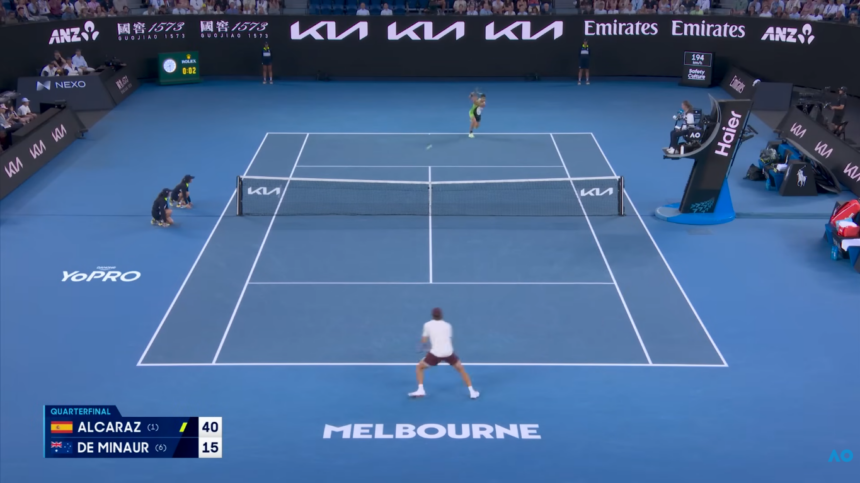
Carlos Alcaraz just moved closer to joining one of tennis’s most exclusive clubs. The top-ranked player absolutely demolished Alex de Minaur 7-5, 6-2, 6-1 in Tuesday’s Australian Open quarterfinal, positioning himself within two wins of completing a career Grand Slam. Two wins. That’s all standing between Alcaraz and immortality. Win the semifinal. Win the final. Become the youngest player ever to win all four major championships in a career. Not bad for a 21-year-old who’s already won three of them.
The scoreline tells you everything about how dominant Alcaraz was. De Minaur, a solid player, walked onto the court at the Australian Open and encountered a version of Alcaraz operating at a level that was simply too high. The first set was competitive. After that? It was just basketball-level dominance. Alcaraz broke De Minaur’s serve with authority, established control, and spent the rest of the match reminding everyone why he’s the world number one.
A career Grand Slam is legitimately one of the hardest feats in tennis history. Only a handful of players have ever won all four major championships in their career. Margaret Court. Serena Williams. Steffi Graf. Rod Laver. Don Budge. That’s the company Alcaraz is chasing. He’s already won the US Open (2022, 2024), Wimbledon (2023, 2024), and the French Open (2024). Australian Open is the missing piece. Win it, and he becomes the youngest player ever to complete a career Grand Slam. Miss it, and the quest continues but the opportunity is still there.
When dominance looks like stepping on an ant
Here’s what separates Alcaraz from virtually every other player on the tour: he doesn’t just win. He overwhelms. He breaks your will. De Minaur came to the Australian Open to compete. He’s a solid player with a competent game. Against Alcaraz, none of it mattered. The top seed established control from the opening games and essentially turned the match into a tutorial on how to play tennis at the highest level.
The first set went to a tiebreaker situation before Alcaraz pulled it out 7-5. That was De Minaur’s moment. That was his chance to steal momentum and build belief. Instead, Alcaraz used it as a springboard. The second set was 6-2. The third set was 6-1. That’s not a match. That’s a demolition. De Minaur got broken multiple times, couldn’t establish any rhythm, and spent the evening watching a world-class player remind him exactly why the rankings are what they are.
Alcaraz finished with the kind of authority that leaves no doubt. He’s not limping into the semifinals. He’s sprinting there on the back of commanding performances. De Minaur had no answer. There was no tactical adjustment that would have changed the outcome. He was simply outclassed.
The Zverev rematch with revenge on the line
Now comes the interesting part: Alcaraz’s semifinal opponent is Alexander Zverev, the 2025 Australian Open runner-up. Their head-to-head record is 6-6, meaning they’re deadlocked in their career matchups. But Zverev holds a significant advantage: he beat Alcaraz in the Australian Open quarterfinal last year. That’s not something Alcaraz has forgotten.
Zverev reached the semifinal by beating Learner Tien 6-3, 6-7 (5), 6-1, 7-6 (3) in an afternoon match. Tien, the 20-year-old, pushed hard in the second and fourth sets but couldn’t quite close the door. Zverev, a two-time Grand Slam finalist, proved why he’s one of the most dangerous players on the tour by saving those key moments and advancing.
The semifinal matchup is intriguing because of the history. Alcaraz wants revenge for last year’s loss. Zverev is hungry after being runner-up here in 2025. They know each other’s games. They know the stakes. This is exactly the kind of match that separates good players from great ones.
Two wins away from tennis immortality
For Alcaraz, this is the narrative that matters now. De Minaur was a stepping stone. Zverev is a test. But the real focus is what comes next: completing the Grand Slam and joining one of the most exclusive clubs in sports history. Two wins. That’s it.