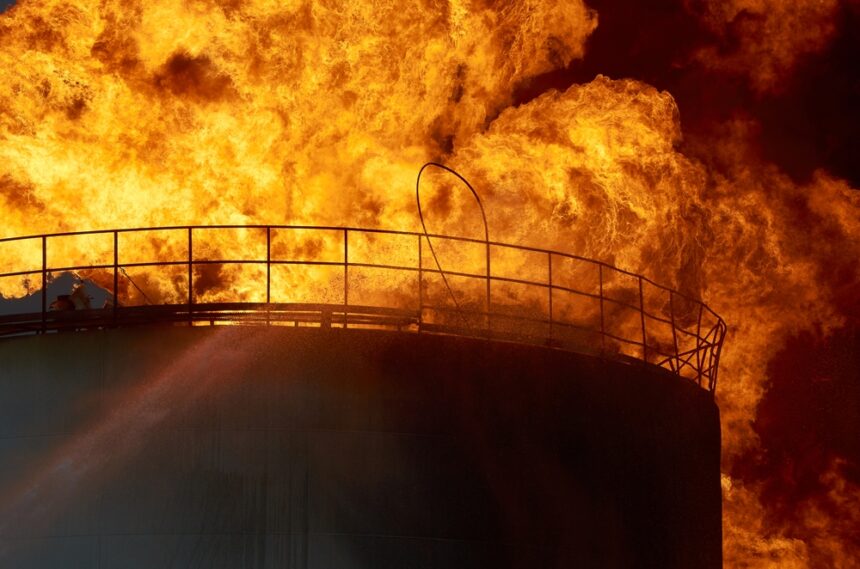
An Iranian military commander says his forces struck a Togo flagged oil tanker attempting to move through the Strait of Hormuz, a claim that lands as Washington weighs its next steps in an escalating confrontation with Tehran.
What does Iran say happened?
An admiral with the Islamic Revolutionary Guards Corps said the vessel, identified as the Trend, was hit and came to a stop after a fire broke out aboard. The account was delivered through Iranian state aligned media rather than a formal government ministry, a distinction worth noting because it allows Tehran to make a claim while retaining some distance from it. He described the transit as an illegal attempt to pass through the waterway under the watch of the U.S. military and issued a broader warning that any vessel making unauthorized passage faces destruction.
How many ships have been hit?
British military maritime monitoring reported that at least three vessels have been struck in and around the Strait of Hormuz over roughly two days. No names, casualty figures or attribution of responsibility accompanied that assessment. The gap matters. Without independent confirmation, the only detailed public account of the tanker strike currently circulating is the one offered by the force claiming to have carried it out.
Why does the Strait of Hormuz matter?
Geography leaves no alternative. The waterway is the sole sea route out of the Persian Gulf, and in ordinary conditions roughly a fifth of the world’s oil passes through it. Pipeline capacity bypassing the strait exists but covers only a fraction of that volume. A sustained disruption does not remain a regional story, because insurance costs, shipping routes and crude pricing adjust globally within days rather than months.
What led to this point?
The confrontation escalated after the United States launched its first strikes against Iran in late February. Tehran has since moved to assert control over the corridor, treating passage as something it permits rather than something guaranteed under international maritime norms. That reframing sits at the center of the dispute. Freedom of navigation through the Strait of Hormuz has been a standing American position for decades, and Iranian claims of transit authority contest it directly.
What is Washington considering?
The Trump administration has not detailed a response. Available options run from expanded naval escort operations for commercial shipping to strikes against the launch sites and small craft used to target vessels. Each carries escalation risk. Escorting convoys through the Strait of Hormuz places American warships within close range of Iranian forces daily, while striking Iranian territory invites retaliation against regional bases and merchant traffic alike.
What does this mean for oil markets?
Traders price risk before they price events. Repeated attacks near the Strait of Hormuz push war risk insurance premiums higher and lead some operators to delay sailings or reroute entirely, which tightens supply whether or not the waterway ever formally closes. Economic damage from uncertainty tends to arrive well ahead of any physical blockade, and it reaches consumers through fuel costs long before it reaches headlines.
What should be watched next?
Three developments will clarify the picture. Whether independent confirmation emerges regarding the vessels struck and the condition of their crews. Whether commercial traffic through the Strait of Hormuz drops sharply in the coming days, which shipping data would show quickly. And whether the United States shifts from deliberation to visible military posture in the Gulf.