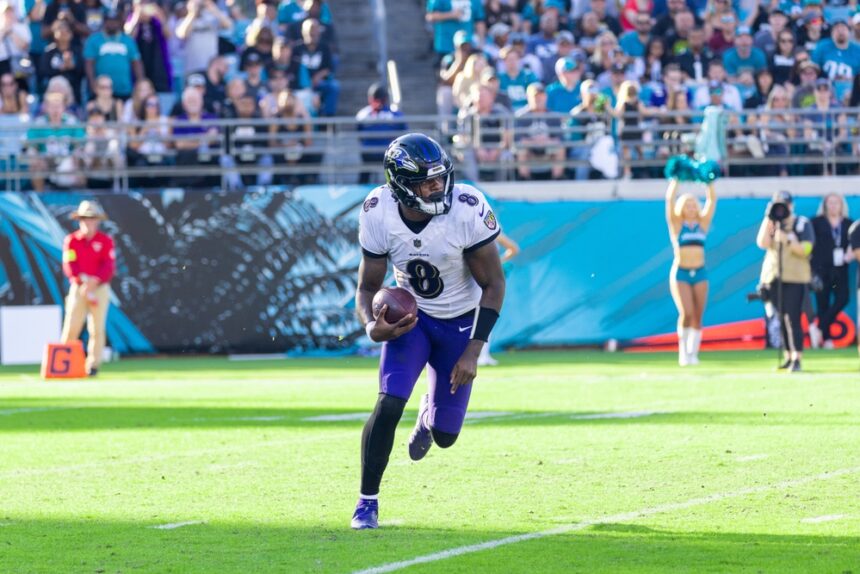
In Pittsburgh during Baltimore’s season finale, Lamar Jackson delivered his finest performance of an otherwise disappointing year. The two-time MVP fired touchdown passes of 50 and 64 yards to Zay Flowers while showcasing his trademark escapability on broken plays. This marked just the second time in NFL history a player threw two go-ahead touchdowns of 50-plus yards in the fourth quarter. Despite the heroics, Tyler Loop’s missed 44-yard field goal sealed Baltimore’s 26-24 loss and an offseason filled with uncertainty.
The question lingering over Baltimore—where was Jackson all season?
Injury Disruptions Derailed Momentum
Jackson’s hamstring injury in Week 4 against Kansas City fundamentally altered his trajectory. Before the injury, Baltimore averaged 37 points per game through three starts. After his return five weeks later, the Ravens failed to crack 30 points in any of Jackson’s 10 remaining starts—the longest drought of his career.
Matt Ryan, former MVP and current Atlanta Falcons president of football, emphasized how limited practice time compounds recovery challenges. For six consecutive weeks, Jackson missed initial practice sessions with various ailments including knee, ankle and toe injuries. During this stretch, he averaged just 177 yards passing with three touchdowns against five interceptions.
Rich Gannon, former MVP and SiriusXM NFL Radio host, highlighted the ripple effects. Missing practice reps impacts not just Jackson but his offensive teammates, limiting crucial red zone work, two-minute drill timing and third-down package execution.
Protection Breakdown Exposed Vulnerability
Jackson endured the worst pass protection of his career in 2025. He was sacked on 9.8% of dropbacks and faced pressure on 37.1% of attempts—second-worst in the league. This contrasted sharply with 2024, when Jackson posted career highs of 4,172 yards and 41 touchdowns behind superior blocking that allowed just 4.3% sack rate.
Kurt Warner, two-time MVP, stressed that offensive line performance remains paramount. Even elite quarterbacks struggle when constantly under duress. The hits, hurries and knockdowns eventually erode confidence and rush decision-making.
Baltimore general manager Eric DeCosta acknowledged the offensive line must improve consistency. With Pro Bowl center Tyler Linderbaum entering free agency and both guard positions needing upgrades, the Ravens face critical personnel decisions.
Rushing Decline Limited Dual-Threat Impact
The most dramatic shift in the quarterback’s game was his rushing production collapse. He carried just 5.2 times per game—three attempts fewer than any previous season. His rushing yards plummeted from a career average of 59.9 per game to only 26.8 in 2025.
Ryan explained this dilemma, saying the player remains the most difficult for defensive coordinators to game-plan against when utilizing his legs. Removing that dimension allows defenses to simplify coverage schemes and reduces offensive stress.
Former Ravens coordinator Todd Monken called his running ability his superpower and averaged 4.4 designed runs per game in his first two seasons. Last season, he dropped to just two per game. He also lacked explosiveness when running, failing to break 20 yards on any carry for the first time ever.
Warner questioned whether Jackson is overthinking situations, perhaps protecting himself from injury rather than instinctively reacting and attacking.
Postseason Pressure Intensifies
New coach Jesse Minter inherits the challenge of revitalizing Jackson while navigating an increasingly competitive AFC. The emergence of Drake Maye and Bo Nix, who led New England and Denver to the conference’s top two seeds, adds complexity.
Baltimore’s persistent playoff struggles prompted owner Steve Bisciotti to fire John Harbaugh after 18 seasons. The Ravens have just three postseason victories in Jackson’s eight years, with Jackson accumulating 11 playoff turnovers since 2018—most of any player in that span.
Despite finishing with his first losing season at 6-7, throwing only 21 touchdowns and averaging 196.1 yards per game, Jackson’s career passer rating of 102.2 and 6,522 rushing yards as a quarterback remain NFL records.
Gannon believes Jackson belongs among the handful of quarterbacks capable of carrying teams to championships. Whether Baltimore can provide the supporting cast and system for Jackson to reclaim his elite form will define both the franchise’s immediate future and the quarterback’s legacy.