

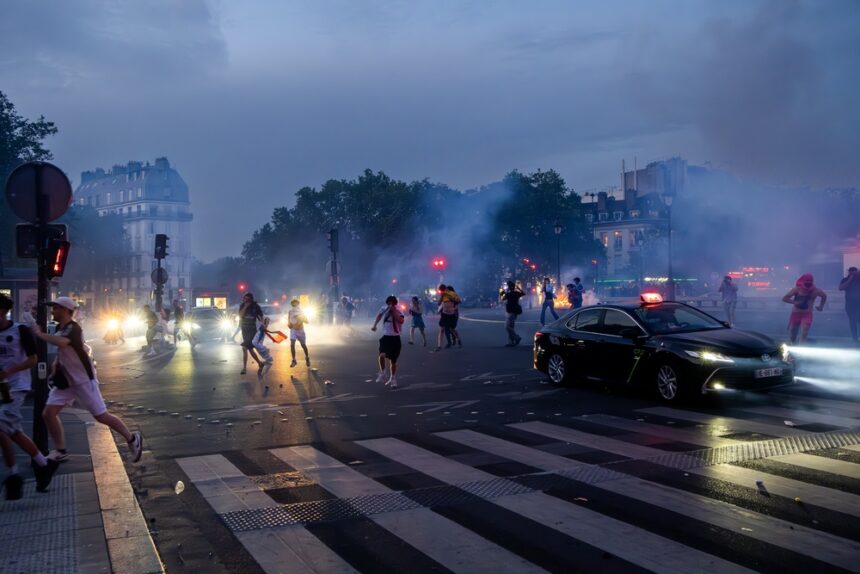
Days after flames and broken glass filled French streets, the fallout has moved into the courtroom.
Paris courts are working through a flood of cases tied to the Paris riots, with defendants brought in one after another before a courtroom packed with journalists, relatives and members of the public on Wednesday, Oct. 21, 2026. Police officers escorted defendants in and out throughout the day as the court worked to keep pace with the arrests.
What happened in court after the Paris riots?
One defendant, 21, accused of joining the Paris riots on Oct. 17, faced a recording of a voice message he had sent on Snapchat. In it, he said he could not film because he was throwing rocks and was in the middle of the action.
He told the court he had said it casually and that he meant he had done nothing. The presiding judge responded that his choice of words was nonetheless revealing. The message was played in court as part of the case against him.
The outcome of his hearing was not immediately known, and defendants are presumed innocent unless convicted. Under French practice, defendants in such cases are often identified publicly only by first name and last initial.
How many people have been arrested?
About 2,500 people were taken into custody across France between Oct. 17 and Oct. 21, according to France’s justice minister. Of those, 917 were referred to prosecutors and 174 were jailed.
In Paris alone, about 300 suspects had been referred to prosecutors by Oct. 20. The capital saw some of the most intense clashes, with fires and looting in central neighborhoods.
How are courts handling Paris riots cases?
The Paris court doubled its daily expedited hearings, known in France as immediate appearances, from two sessions to four to handle the volume. Court staff, judges and lawyers have faced long days as the cases pile up.
Immediate appearances allow prosecutors to bring suspects before a judge within days of arrest. The process is commonly used after unrest in France and can lead to quick sentencing. Defendants can request more time to prepare, though they may be held in custody while they wait.
Critics of the system say the speed can limit defendants’ ability to prepare, while supporters argue it delivers swift accountability. Rights groups have raised similar concerns after past waves of unrest, including the 2023 riots that followed the police shooting of a teenager near Paris.
What caused the Paris riots?
The unrest grew out of protests over economic hardship and conditions in schools before turning violent. Rioters targeted city halls, public buildings and hundreds of businesses in Paris, Marseille, Lyon and other cities. The violence began on Oct. 17 and spread across the weekend.
It was the worst urban violence France had seen in years. Paris imposed overnight curfews in parts of the city, and the interior minister offered to resign, though President Emmanuel Macron refused. Macron called for full transparency about failures in planning and intelligence.
What comes next after the Paris riots?
More protests are planned for this weekend, and the government says soldiers will take over some guard duties to free up police. The prime minister has blamed violent groups on the far left, while opposition lawmakers say the government is ignoring anger over public services and the cost of living.
For the courts, the Paris riots cases are likely to keep coming for weeks. Officials have signaled that they intend to pursue charges against those involved in the worst damage.
How the justice system handles them, and whether the weekend passes peacefully, will shape how France moves on from the Paris riots.