The Indiana Fever built something genuinely special over the past two seasons a team that battled through injuries, captured the attention of a rapidly growing fan base and pushed all the way to Game 5 of the semifinals in 2025. But the new WNBA collective bargaining agreement has introduced a financial reality that threatens to dismantle the core of that group before it ever reaches its full potential.
The central tension comes down to three players and one salary cap. Caitlin Clark, Aliyah Boston and Kelsey Mitchell are all max contract players under the new CBA structure. With a starting salary cap of $7 million more than four times the $1.5 million cap from 2025 that might sound like plenty of room. The numbers, however, tell a more complicated story.
What the new CBA actually means for Indiana Fever’s math
The new WNBA and WNBPA agreement, widely described as transformational, established a super-max salary of $1.4 million per player. Keeping all three stars on max deals would consume $3.6 million of the $7 million cap more than half leaving just $3.4 million to fill the remaining nine roster spots. That works out to roughly $370,000 per player, a figure that makes building a genuinely competitive supporting cast around those three nearly impossible.
A key element of the new deal is a provision called EPIC, which applies to players on rookie contracts. It allows them to renegotiate what would have been the fourth year of their rookie deal into a three-year extension, and to earn max or super-max money based on prior All-WNBA selections or MVP awards. Both Clark and Boston qualify under that provision. Boston is immediately eligible and is widely expected to secure a max contract this season. Clark’s max deal is already factoring into Indiana’s planning for 2027.
The result, according to analysts following the situation closely, is that retaining all three players simultaneously is essentially off the table by 2027.
Kelsey Mitchell is at a crossroads
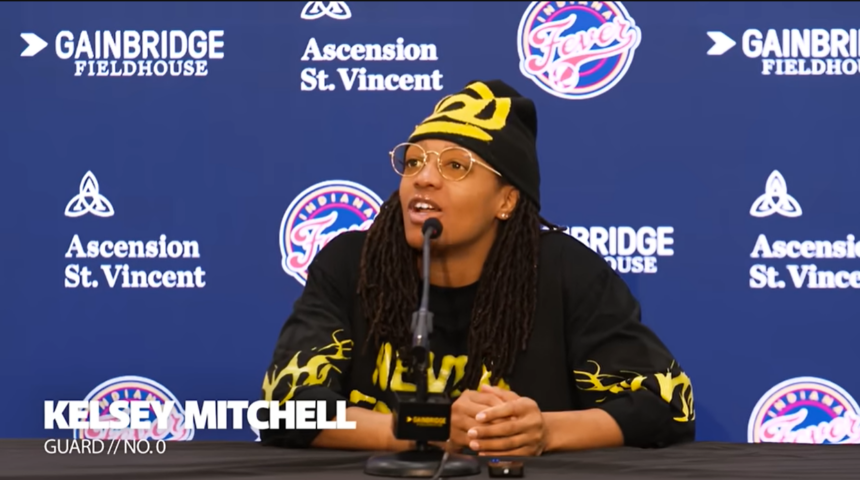
Indiana Fever general manager Amber Cox has been consistent in stating that Mitchell is the team’s top retention priority this offseason. The 30-year-old guard has earned that standing. In 2025, she averaged a career-high 20.2 points and 3.4 assists per game, nearly carrying an injury-depleted Fever squad through a deep playoff run largely on her own.
The question is whether a one-year super-max deal with Indiana is actually in Mitchell’s best interest at this stage of her career. Expansion teams entering the league would likely be willing to offer her a longer commitment three or four years at the super-max level providing both financial security and a featured role. At 30 and in peak form, this is precisely the window when a player of Mitchell’s caliber should be locking in the best possible long-term contract.
If she stays with Indiana for one year at the super-max, her role could shrink when Clark returns fully healthy and resumes her commanding presence. There is a real possibility that Mitchell’s value and leverage are higher right now than they will be at 31, making a long-term offer from another franchise genuinely attractive.
The Fever’s management could also explore a middle path giving Mitchell the super-max for one year and then restructuring from there but that still requires Mitchell to accept uncertainty about her future earning potential with the franchise.
Indiana Fever will still be a destination without Mitchell
As difficult as losing Mitchell would be, the Fever enter any offseason with one of the most powerful recruiting tools in the league: Caitlin Clark. More than 100 players are set to enter free agency, and the opportunity to play alongside the sport’s most visible star carries enormous appeal not just competitively but in terms of brand exposure and marketability.
The 2025 Fever roster demonstrated what a motivated group of players can accomplish when they buy into a shared mission. Several players on hardship contracts gave performances that endeared them to the fan base, and the chemistry built under coach Stephanie White proved durable under pressure.
The roster will look different next season. That much appears certain. But the foundation Clark provides as a player who elevates teammates and draws attention to everyone around her means Indiana will remain one of the more attractive destinations in the league regardless of how the Mitchell situation resolves.