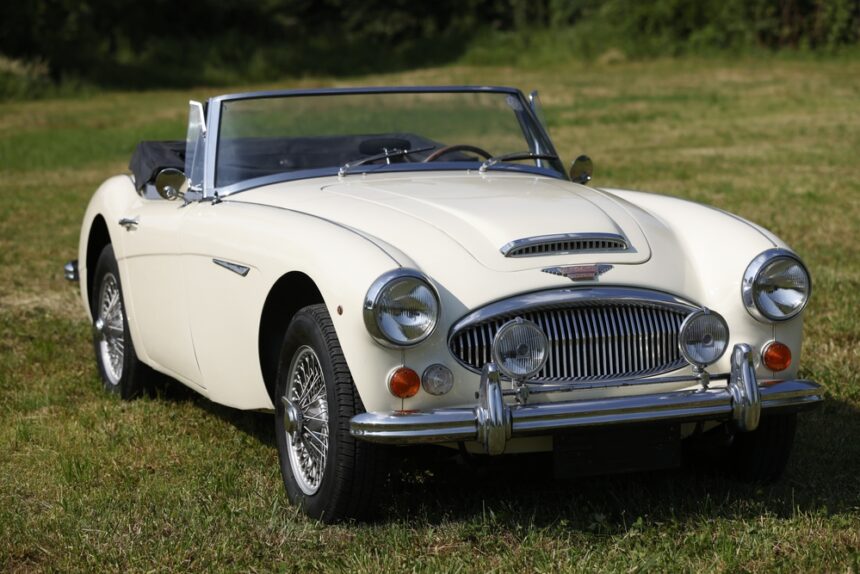
Some cars age. The Austin-Healey 3000 does not. It simply waits — parked at a show, gleaming under an open sky, drawing a crowd that includes people who were not yet born when the last one rolled off the line. There is a reason for that. This car was never just transportation. It was a statement, a sensation, and one of the most genuinely thrilling open-top driving experiences that British engineering ever produced.
Built from 1959 until 1967, the Austin-Healey 3000 is the best known of the Big Healey models — a British sports car whose bodywork was crafted by Jensen Motors and assembled at BMC’s MG Works in Abingdon. It came into the world with something to prove, and it spent nearly a decade doing exactly that.
Austin-Healey and the American Connection
From the very beginning, the Austin-Healey was designed with American buyers in mind. Donald Healey recognized that the U.S. market represented his best opportunity — and American enthusiasts were quick to support the lively, attractive machine, firmly establishing Austin-Healey’s reputation on this side of the Atlantic.
The numbers made that connection undeniable. In 1963, 91.5 percent of all Austin-Healey 3000 cars were exported, with the majority heading to North America. This was not a British car that happened to find some American fans. It was a British car built, in many ways, for America — and America responded with open arms.
That relationship has never really ended. Today, Austin-Healey 3000s can be found listed for sale across the United States, with prices ranging from around $17,500 for project cars to over $135,000 for fully restored examples. For a car that stopped being made decades ago, that kind of market presence says everything.
The Performance That Built a Legend
The Austin-Healey 3000 was not just a pretty face. It featured a 3.0-liter engine, front disc brakes, side windows, a fold-up top, and power brakes — steadily refined across its production run without sacrificing its sporting character.
Rally success was not incidental — it was defining. Pat Moss and Ann Wisdom famously drove a 3000 to overall victory at the Liège-Rome-Liège Rally in 1960, cementing the car’s reputation as a genuine competitor. Its competition history includes appearances at major circuits including Sebring in the USA, Le Mans in France, and Bathurst in Australia. It won its class in many European rallies and is still raced in classic car competitions today.
What It Costs to Own One Today
The Austin-Healey 3000 Mk III remains surprisingly accessible relative to its legendary status. Based on the latest 2026 auction results, here is what buyers can expect
- Driver Quality (road-ready, not show-perfect)—$32,000 – $45,000. A 1966 model sold in March 2026 for $32,500.
- Excellent/Well-Restored (show-ready)—$65,000 – $80,000. A 1965 model fetched $67,200 at a major Arizona auction in early 2026. A separate 1965 example sold for $74,130 in March 2026.
- Concours/Pristine (museum quality)—$125,000 and above. A record-breaking 1967 model sold for $585,000 in June 2025.
The average sale price for an Mk III currently sits around $54,457 — strong enough to reflect genuine collector demand while remaining within reach for serious enthusiasts.
Where to Find One and What to Watch For
For buyers ready to start the hunt, three platforms dominate the classic car marketplace:
- Bring a Trailer — frequent Austin-Healey auctions with transparent bidding history
- Hemmings — wide range of private seller and dealer listings from $26,000 to $80,000
- Classic.com — ideal for tracking market value and comparing active listings across multiple sites
Before pulling the trigger, keep these tips in mind:
- BJ8 Phase 1 vs Phase 2 — The Phase 2, released in May 1964, offers higher ground clearance and improved rear suspension, making it the better choice for drivers planning to use it regularly.
- Rust — The biggest enemy of any Big Healey. Always inspect the chassis and body panels thoroughly before committing to a deal.
- Parts availability — No need to worry here. A thriving aftermarket ecosystem means quality components are widely available, making restoration and maintenance far more manageable than the car’s age might suggest.
A Design That Time Cannot Touch
The exterior of the Austin-Healey 3000 is a masterclass in proportion — its long bonnet, pronounced wheel arches, and distinctive vertical-slat grille exude motion even at a standstill. Inside, rich leather and polished wood speak to the craftsmanship of the era.
It offers confident highway manners and a presence that most other small British cars simply cannot match — a 1950s design powered by 1960s muscle. That combination of timeless looks, genuine performance, deep history, and a thriving support network is exactly why the Austin-Healey 3000 keeps finding new admirers decade after decade. It does not need to be reinvented. It just needs to be discovered.