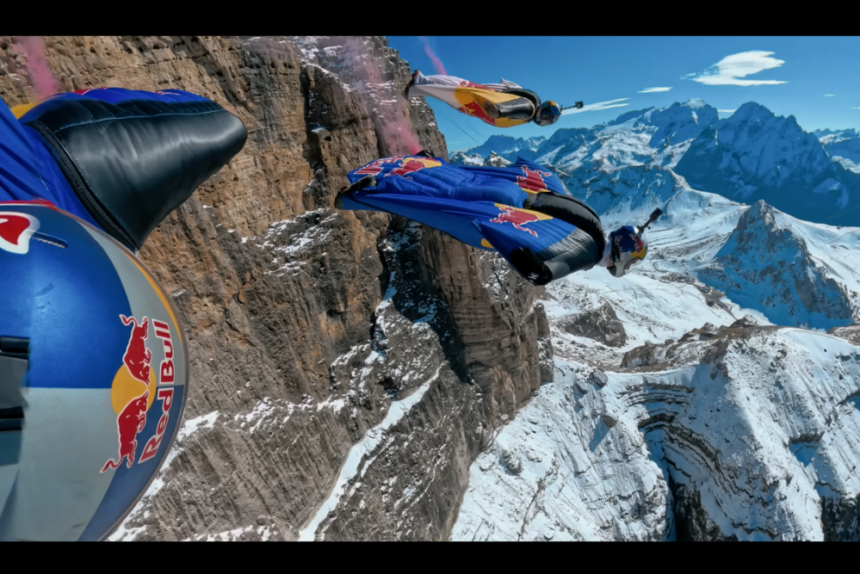
There are extreme sports, and then there is whatever Red Bull just pulled off. The energy drink brand turned global sports powerhouse has spent decades raising the bar on human performance — and its latest aerial spectacle may be the most audacious thing it has ever put together.
A team of the world’s best aerial athletes and precision pilots gathered to take on a flying obstacle course unlike anything ever attempted. The result was a jaw-dropping collision of speed, creativity, and sheer nerve — all played out thousands of feet above the ground.
What Made This Flying Obstacle Course So Extreme
The course was not simply a straight-line speed challenge. It was a complex, multi-layered gauntlet designed to test every dimension of aerial skill. Athletes navigating the course encountered:
- Jet planes cutting across flight paths at high speed
- Paramotors weaving through tight aerial corridors
- Skydivers dropping into the course from above
- Catapults launching objects directly into the flight zone
- Skyscrapers serving as towering navigational markers
- Drones operating as precision obstacles throughout
Each element demanded split-second decision-making and an almost superhuman level of spatial awareness. One miscalculation at speed — and the consequences would be catastrophic.
Wingsuiters at the Heart of the Challenge
At the center of the action were the wingsuiters — athletes who strap into specially designed suits that transform the human body into a gliding machine. Wingsuit flying is widely regarded as one of the most technically demanding and unforgiving disciplines in all of extreme sports. Pilots must maintain precise body positioning to control speed, altitude, and direction simultaneously, all while reading the environment around them in real time.
In this course, wingsuiters were tasked with threading through a series of obstacles that left almost no margin for error. The combination of moving hazards, fixed structures, and unpredictable aerial traffic pushed the discipline into entirely new territory. What Red Bull constructed was less an obstacle course and more a living, breathing aerial puzzle — one that only the most elite pilots in the world had any business attempting.
Red Bull’s Legacy of Pushing Human Limits
This latest feat fits squarely within Red Bull‘s long tradition of engineering experiences that sit at the very edge of what humans can physically achieve and mentally endure. From Felix Baumgartner’s stratospheric freefall to cliff diving world series events and speed sailing championships, the brand has built its identity around one core belief — that the limits of human performance are always further than they appear, often beyond what most would ever imagine.
The flying obstacle course adds a new chapter to that impressive legacy. It is a vivid reminder that extreme sports are not simply about danger for its own sake. At their best, they are about precision, preparation, and the extraordinary things that become possible when the right athletes are given the right challenge, tools, and support to push boundaries safely and creatively.
Why Extreme Flying Is Capturing a New Generation of Fans
Aerial extreme sports have seen a surge in global interest over the past decade, fueled in large part by high-production video content that puts viewers inside the experience like never before. The visceral, first-person perspective of wingsuit flying — combined with the cinematic scale of a production like this one — creates something that traditional sports simply cannot replicate.
For a new generation of extreme sports fans raised on immersive digital content, events like Red Bull’s flying obstacle course are not just entertaining. They are genuinely inspiring — proof that human beings, given enough skill, preparation, and courage, can do things that look impossible from the ground.
The sky, it turns out, is not the limit. It is just the starting point.