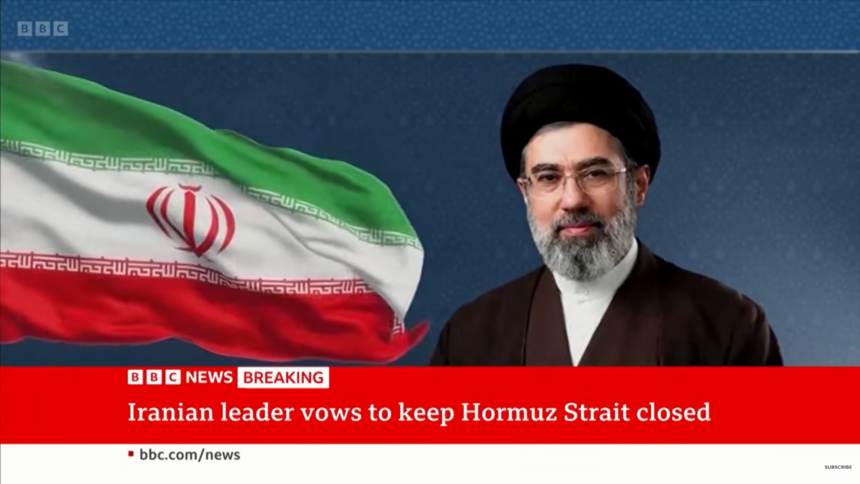
The world did not have to wait long to hear from Iran’s new supreme leader. Ayatollah Mojtaba Khamenei, appointed over the weekend following the assassination of his father, used his first public statement to draw a firm line on the Strait of Hormuz and to signal that Iran had no intention of softening its posture in its ongoing conflict with the United States and Israel.
The 56-year-old hardline cleric delivered his remarks through a written statement read on state television, which has not yet broadcast live images of him. The tone was unambiguous. Iran would keep the strait closed, and if the fighting continued, new military fronts would be opened in areas where Iran’s adversaries were considered vulnerable and unprepared.
A waterway the world depends on
The Strait of Hormuz has been effectively shut since Israel and the United States launched strikes on Iran on February 28, triggering the broader conflict now reshaping the Middle East. The strait is among the most consequential shipping corridors on the planet, carrying roughly one fifth of the world’s oil and natural gas through a narrow passage that connects the Persian Gulf to the broader global energy market.
Its closure has sent shockwaves through commodity and bond markets alike, pushing oil prices toward and briefly past $100 a barrel. Brent crude was trading just under that threshold as of Thursday afternoon in London. The disruption has stoked fears of sustained inflationary pressure, with economists and central bankers weighing whether price increases driven by constrained energy supply could force interest rate increases at a moment when economies are already under strain.
Diplomacy at an impasse
Behind the scenes, efforts to broker a reopening of the strait have made little meaningful progress. Saudi Arabia, Oman and Turkey have been leading mediation efforts, supported by European governments. Qatar, which had previously been involved in back-channel contacts, stepped back from those discussions after sustaining repeated Iranian attacks.
People familiar with the state of those negotiations described the gap between the parties as wide, with no breakthrough appearing imminent. The reopening of the strait has been the central demand threading through all of the diplomatic activity, but Iran under its new leader appears in no hurry to concede that point.
Trump weighs in from Washington
In Washington, the political pressure on President Donald Trump to resolve the crisis is building. Disruptions to global energy supply carry immediate economic consequences for American consumers and trading partners alike, and the administration has faced growing calls to accelerate diplomatic efforts.
Trump addressed the situation shortly before Khamenei’s statement was released, making clear that his priority remained preventing Iran from developing nuclear weapons and eliminating what he described as the broader Iranian threat. He also pointed to the United States’ position as the world’s largest oil producer as a reason the country could absorb higher prices more comfortably than others, framing rising oil revenues as a potential benefit rather than purely a burden.
What comes next
Khamenei’s remarks about opening additional fronts in the conflict added a new dimension to an already volatile situation. The reference to areas where Iran’s enemies have little experience and high vulnerability was widely read as a signal that the war could expand beyond its current geography if no resolution is reached.
For markets, for diplomats and for governments across the region, the message from Iran’s new supreme leader was clear. The era of waiting to see what kind of leader Khamenei would be is already over.