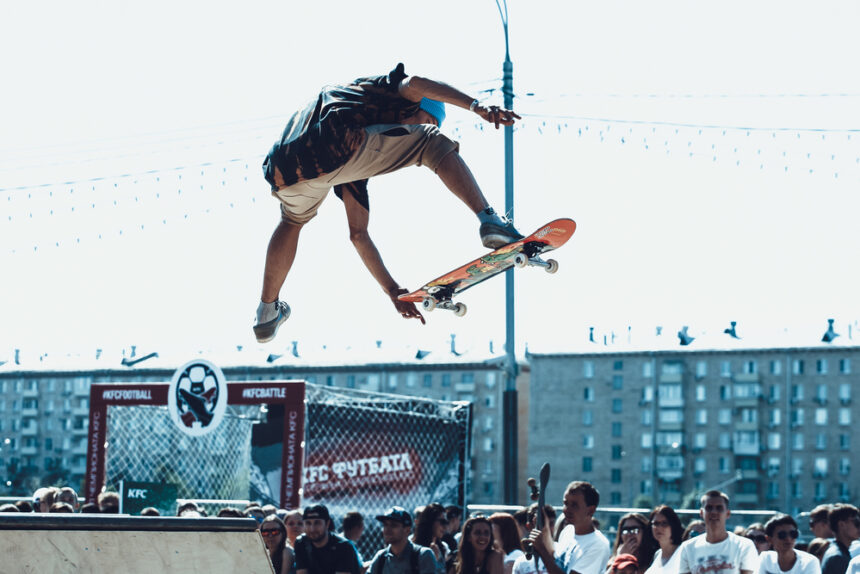
Not long ago, skateboarding was the sport parents warned their kids about. It was loud, it was dangerous, and it had absolutely no interest in being respectable. Skaters claimed empty parking lots, stairwells, and concrete ledges as their own — building a culture from the ground up, quite literally.
That rebellious foundation is exactly what makes skateboarding’s mainstream arrival so extraordinary. The sport did not soften itself to earn acceptance. The world simply caught up.
Today, skateboarding stands as one of the fastest-growing sports on the planet. It commands global audiences, drives billion-dollar industries, and carries a cultural weight that extends far beyond any halfpipe or skate plaza. What changed — and how did it happen so fast?
The Olympic Moment That Changed Everything
The turning point arrived at the Tokyo 2020 Games, when skateboarding made its Olympic debut and immediately captivated the world. What viewers witnessed was unlike anything traditional sports had offered before. Competitors hyped each other up between runs. Athletes wept with joy for rivals who landed clean tricks. The entire atmosphere felt less like a competition and more like a celebration.
Skateboarding’s Olympic presence proved the sport could scale without losing its spirit. The 2024 Paris Games reinforced that truth, delivering some of the most watched moments of the entire event. Young athletes, some barely in their teens, were landing technically elite tricks on the world’s biggest stage — and doing it with a style and swagger that no training manual could ever script.
What made those Olympic runs so unforgettable:
- Competitors openly celebrated each other’s best performances
- Creative expression was rewarded alongside technical execution
- The youngest athletes frequently outshone their more experienced peers
- Street and park disciplines each brought a completely distinct energy
- Global audiences discovered the sport’s emotional depth for the first time
Skateboarding Shapes Culture Beyond the Board
The reach of skateboarding has never been confined to sport alone. Its influence threads through fashion, music, film, and digital media in ways that are difficult to overstate. Entire fashion empires have been built on skate aesthetics. The visual language of skateboarding — raw, unfiltered, and anti-corporate — has become one of the most copied styles in modern design.
On streaming and short-form video platforms, skateboarding content consistently ranks among the most engaged categories. Clips of riders landing impossible tricks in unexpected urban environments pull massive viewership, driven by audiences who respond to authenticity over production polish. The culture’s refusal to be manufactured is precisely what makes it magnetic.
Video games like Tony Hawk’s Pro Skater introduced millions to skateboarding’s vocabulary before they ever stepped on a deck, seeding generations of future fans and athletes worldwide.
A New Era of Skateboarders Is Taking Over
The current generation of skateboarders is the most technically advanced in the sport’s history. Tricks that were considered the ceiling of human ability two decades ago are now warm-up moves. Skate parks have multiplied across every continent. Youth programs are introducing the sport to kids in cities where concrete and creativity are the primary raw materials.
The landscape of skateboarding in 2026 looks like this:
- Female athletes are competing at elite levels and commanding major sponsorships
- Youth skate programs are expanding rapidly in urban communities worldwide
- Independent skate brands continue to thrive alongside global corporate investment
- International talent from Japan, Brazil, and Australia is consistently raising the bar
- Mental health conversations within the skate community are growing more visible and vital
Skateboarding has always taught the same core lesson — fall down, get up, try again. That cycle of failure and persistence is not unique to the sport, but few disciplines embody it as honestly or as visibly.
Skateboarding Is Only Getting Started
The global skateboarding market is on track to exceed five billion dollars by 2027. New skate parks are opening in cities that had none a decade ago. Brands that once dismissed the sport are now competing aggressively for placement within it.
Yet none of that commercial momentum is the real story. The real story is that skateboarding remains one of the last major sports where a rider answers to no one but themselves. No playbook, no prescribed form, no ceiling on creativity.
In a world that rewards conformity, skateboarding keeps choosing freedom. That choice is why the sport is not just surviving — it is thriving.