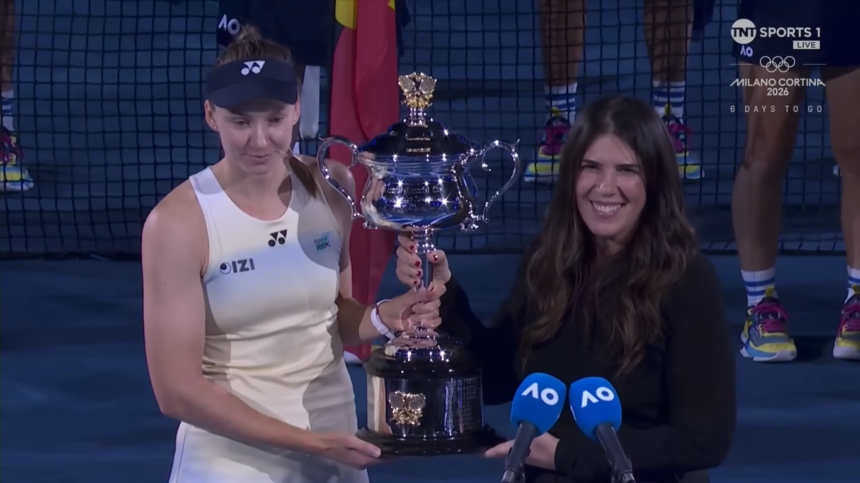
Kazakhstan star storms from behind in third set to win second Grand Slam and avenge previous losses to world No. 1
Elena Rybakina is an Australian Open champion. The world No. 5 stormed from behind in the deciding set of Saturday’s final to overcome top-ranked Aryna Sabalenka 6-4, 4-6, 6-4 at Rod Laver Arena, claiming her second Grand Slam title and avenging her losses to the four-time Grand Slam champion in the 2023 Australian Open final and the 2021 Wimbledon final.
The match was a tale of razor-thin margins. Both players finished having won exactly 92 points. But in the key moments when it mattered most Rybakina was the one who stepped up. She won 64% of points when the score was locked at 30-30 or 40-40. She won 75% of points when facing a break point. She made 72% of her third-set service returns land in play. Those are the statistics that separate champions from runners-up.
Sabalenka had appeared to seize control of the match early in the third set, breaking Rybakina just the second time in the match and racing to a 3-0 lead. The momentum seemed to be firmly in her favor. The world No. 1 was playing aggressive tennis. She was dictating points. She was doing what she does best overwhelming opponents with power and relentless aggression.
Then Rybakina responded. She won five consecutive games to wrestle back control. She calmly served out the match with an ace to clinch the title in 2 hours and 18 minutes. When the final point was struck, she clapped her left hand on the strings of her racket and held her arm up triumphantly as the packed grandstands roared in delight.
“It’s amazing to hold this trophy,” Rybakina said after the match. “I knew that today if I get a chance to lead that I will need to try some risky shots and just go for it. It was tough to come back in the third. I’m happy that being down, I was able to calm myself down, not being frustrated anymore, and just focus on each point and stay close.”
That’s the mindset of a champion not panicking when things go wrong, staying composed under pressure, and executing when it matters most.
When Aggression Meets Aggression
What made Rybakina‘s victory particularly impressive was her willingness to match Sabalenka’s aggression with her own brand of heavy ballstriking and fearless tennis. She didn’t try to outsteady the world No. 1. She didn’t try to win from the baseline through patience and attrition. She met Sabalenka’s power with her own power, her own aggression, her own willingness to take risks.
That approach was evident from the opening game, when Rybakina broke Sabalenka’s serve with high-risk, high-reward tennis despite Sabalenka landing seven of eight first serves. She was signaling her intent immediately: I’m not here to survive this match. I’m here to win it.
Sabalenka, in defeat, acknowledged Rybakina’s superiority in the key moments. “I played great until a certain point, and then I couldn’t resist that aggression that she had on court today,” Sabalenka said. “She played incredible. Today she was a better player.”
That’s gracious acceptance of defeat from the world No. 1, but it also speaks to the reality of what happened Rybakina simply outplayed her when it mattered most.
The Return to Championship Glory
Rybakina’s Australian Open title caps a monumental resurgence. She will rise to world No. 3 when the WTA’s latest rankings are released Monday. But her success extends far beyond this single tournament. Since Wimbledon last year, Rybakina has posted a tour-best 37-6 record. She won the season-ending WTA Finals in Riyadh, Saudi Arabia. She’s now won 10 consecutive matches against top-10 opponents a career-best streak that includes this victory over Sabalenka.
“I always believed that I could come back to the level I was,” Rybakina said. “Of course, we all have ups and downs. I think everyone thought maybe I will never be again in the final or even get a trophy, but it’s all about the work. When you get some wins, big wins against top players, then you start to believe more. You get more confident.”
That’s the narrative of her comeback not just winning an Australian Open title, but proving to everyone, including herself, that she could return to the elite level after years of uncertainty.
The Daphne Akhurst Memorial Cup was presented by 2001 and 2002 Australian Open champion Jennifer Capriati, adding another layer of history to Rybakina’s triumph. She’s now a two-time Grand Slam champion. She’s climbed back to world No. 3. She’s avenged her previous losses to Sabalenka. And she’s proven that her resurgence isn’t a momentary flash it’s a genuine return to elite-level tennis.
For Sabalenka, the loss represents consecutive Australian Open final defeats. She won the title in 2023 and 2024 before losing to Madison Keys last year and now to Rybakina this year. Despite entering the final with a 12-match winning streak and 22 consecutive sets won to start the year, she couldn’t maintain that momentum in the match that mattered most.