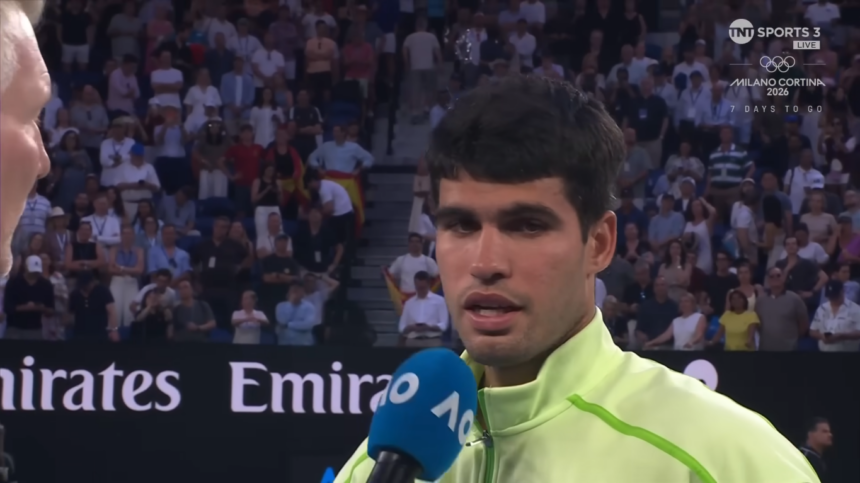
22-year-old fights back from two points away from defeat to reach first Melbourne final and position for historic career Grand Slam
Carlos Alcaraz was two points away from elimination. His body was failing him. His movement was compromised. His Australian Open dream was on the verge of collapse. Then he fought back. In a match that lasted 5 hours and 27 minutes the longest semifinal in Australian Open history the 22-year-old refused to quit. He refused to accept defeat. He refused to let his body’s limitations define the outcome.
Alcaraz defeated Alexander Zverev 6-4, 7-6 (5), 6-7 (3), 6-7 (4), 7-5 in what he’s calling one of the best matches he’s ever won. More importantly, he advanced to his first Australian Open final and, at 22 years old, became the youngest man in the Open era to reach the finals of all four Grand Slam events. One more win means he becomes the youngest to complete a career Grand Slam.
But getting to this point required everything Alcaraz had left emotionally and physically.
The third set is where things fell apart. Alcaraz had been dominant through two sets, two points away from a semifinal victory without having dropped a set through five rounds. He was the favorite. He was playing the way that won him the US Open and helped him evenly split the past eight majors with Jannik Sinner. Then his upper right leg started failing him.
During the ninth game of the third set, Alcaraz started limping and clutching his upper right leg. It wasn’t traditional cramping at least not at first. The pain was isolated to his right adductor muscle, concentrated in one place rather than widespread. After holding for 5-4, he took a medical timeout during the changeover. Three minutes. Treatment. Massage. A desperate attempt to get something working again that had stopped working.
Zverev wasn’t happy about it. The 2025 runner-up disputed the medical timeout, arguing that cramping doesn’t typically qualify for that kind of break. He raised his concerns with a tournament supervisor. He made his displeasure known. But the timeout happened anyway. And when Alcaraz returned, something had shifted. Not his physical condition he still wasn’t right. But his mental state. His determination. His refusal to accept the outcome everyone assumed was coming.
When the body breaks but the mind remains unbroken
What happened next was a masterclass in mental toughness. Alcaraz’s footwork wasn’t up to his usual standard. He knew it. Everyone watching knew it. But he kept fighting anyway. He navigated the third and fourth sets, losing both in tiebreaks, but never surrendering. When he dropped serve in the first game of the fifth set and fell behind, the narrative seemed settled. Zverev was the survivor now. Zverev had outlasted the injured favorite.
Then Alcaraz started pushing back. He didn’t break back immediately. He waited. He kept the pressure on. He forced Zverev to hold serve repeatedly. And in the tenth game, when Zverev was serving for the match at 5-4, Alcaraz finally converted his break point. The momentum shifted. The pressure reversed. Zverev, after four-plus hours of fighting, ran out of steam.
“I think physically we just pushed each other to the limit today,” Alcaraz said. “We pushed our bodies to the limit. Just really, really happy to get the win, that I came back.”
In the sixth game of the fifth set, there was a moment that defined the match’s trajectory. Alcaraz sprinted across court to track down a drop shot and slid at full pace for an angled forehand winner. The crowd erupted. Alcaraz was back. Not just physically present, but mentally engaged, fighting for every point like his tournament depended on it—because it did.
When the impossible becomes inevitable
Alcaraz won the last four games. He clinched it on his first match point, letting his racket slip and flopping on the court, lying on his back in exhaustion and elation. When he got up, Zverev came around the net for a congratulatory hug. The longest Australian Open semifinal ever was finished.
The match surpassed the 2009 classic between Nadal and Verdasco. It was the longest match of the tournament. It was arguably the best match Alcaraz has ever won not because it was pretty, but because of what it demanded from him emotionally and physically.
At 22, Alcaraz is now the youngest man in the Open era to reach the finals of all four majors. One more victory and he becomes the youngest to complete a career Grand Slam. But first, he faces either Sinner or Djokovic a player bidding for an unprecedented 25th title.
After what Alcaraz just did, don’t doubt he’ll find a way.