Third seed exits quarterfinals to Svitolina after smashing racket seven times on live television
Coco Gauff’s Australian Open campaign ended the way it probably deserved to: with seven racket smashes, five double faults in the first set, and a lopsided 6-1, 6-2 loss to Elina Svitolina in just 59 minutes. The third-seeded Gauff, a two-time major winner at just 21 years old, walked onto the court against Svitolina and simply fell apart. Her serve abandoned her. Her composure abandoned her. Her tournament was finished before the clock hit an hour.
What made this exit particularly painful wasn’t just the loss itself. It was what happened after. Gauff tried to find a private corner of Rod Laver Arena to let her frustrations out. She pounded her racket seven times on a concrete ramp, presumably thinking the cameras wouldn’t catch it. Spoiler alert: they absolutely caught it. Every. Single. Smash. There’s essentially nowhere in a Grand Slam venue that isn’t within camera range anymore, and Gauff’s emotional release became a televised moment rather than a private moment of catharsis.
That’s the broader story here: a player struggling with both performance and the reality of playing in the modern sports media age.
When your serve becomes your worst enemy
Let’s start with the numbers because they tell the whole story. Gauff hit just three clean winners across 15 games. Three. She made 26 unforced errors. She won only 41% of the points on her first serve despite getting 74% of them into play. But the real killer? She won just 2 of 11 points on her second serve. That’s not a serving problem. That’s a complete mechanical and mental breakdown on serve.
In the first set alone, Gauff double-faulted five times. Svitolina broke her serve four times in that same set. For a player who’s supposed to be a top-three talent globally, that’s not just bad. That’s embarrassing. You can’t compete at the Grand Slam level when your serve is that unreliable. You’re basically playing without your most important weapon.
Gauff’s serve has been a consistent strength throughout her career. She made her Grand Slam debut at 15, won her first major at 19, and has carried herself like a future Hall of Famer since breaking through. But on Tuesday, that serve disappeared entirely. Whether it was nerves, mechanics, or just one of those catastrophic days where everything goes wrong, the result was the same: she got broken six times in two sets and couldn’t recover.
The camera problem nobody talks about
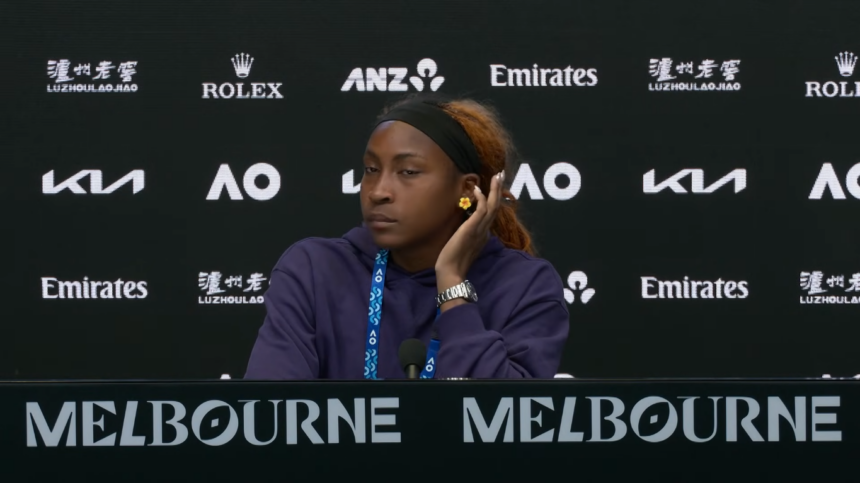
After the match ended, Gauff addressed something that felt more important to her than the actual loss: the fact that her emotional release was broadcast to the world. She smashed her racket seven times, trying to do it away from cameras, but modern Grand Slam venues don’t really have private spaces except the locker rooms. Those seven smashes made it onto broadcasts and into highlight reels.
Gauff acknowledged that she broke one racket at the French Open and swore she wouldn’t do it again on court. She felt it set a bad example, especially for kids watching. But she also felt she needed an outlet for the emotions building up during a match where everything went wrong. So she found what she thought was a private moment and let it out. Except it wasn’t private at all.
“Certain moments don’t need to be broadcast,” Gauff said, pointing out that even top-ranked Aryna Sabalenka dealt with similar camera coverage after emotional moments. The broader point: players are caught between needing outlets for legitimate frustrations and the reality that there’s no privacy in professional sports anymore.
A pattern emerging
This is Gauff’s second consecutive quarterfinal exit at the Australian Open. Her best result here was 2024 when she reached the semifinals. For a player of her caliber, that’s a concerning trend. She’s still only 21, still has massive upside, but these early exits at majors are starting to add up.
The serve collapse against Svitolina wasn’t just a bad day. It was a reminder that even elite players have matches where everything goes sideways. Gauff will be back. She’ll figure out her serve. She’ll win more majors. But this particular Australian Open run is done, and the way it ended on television, with racket smashes and frustration will linger longer than the match itself should matter.