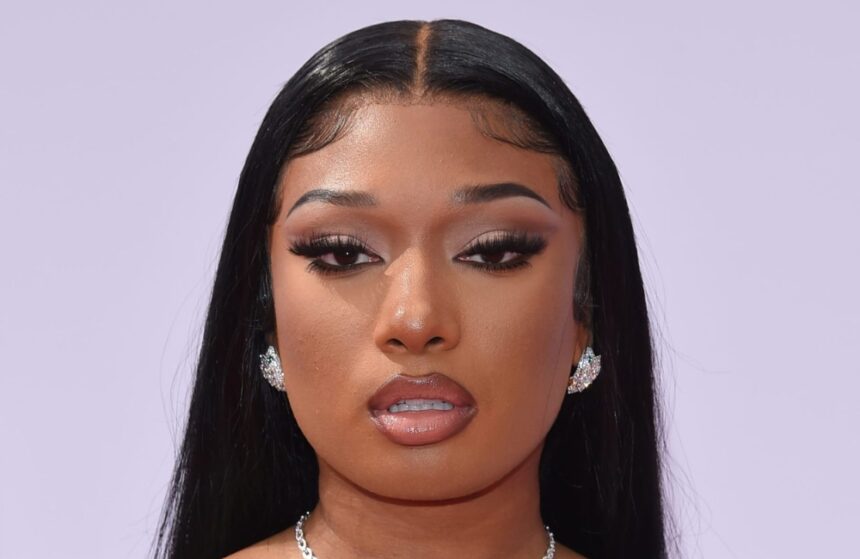
When news broke that Megan Thee Stallion and NBA champion Klay Thompson had ended their relationship, many expected the conversation to center on what she had been through. What followed instead was something far more familiar and far more troubling.
Rather than sympathy for a woman who had publicly experienced betrayal, a significant portion of online commentary turned toward dissecting her, questioning her decision to speak out, and recycling old criticisms that had nothing to do with the situation at hand. It was a pattern Megan has lived through before, and one that reflects a much larger problem in how the public engages with women especially Black women when their personal lives become news.
A relationship that seemed built for the long run
By most accounts, Megan and Thompson had developed something real. The two were seen together at family gatherings, appeared at public events and gave every indication of a relationship with staying power. When Megan confirmed the split and cited infidelity as the cause, the expectation might have been that people would take her at her word and respond accordingly.
Instead, the focus shifted almost immediately. Online spaces filled with commentary that questioned her credibility, revisited her past and, in many cases, suggested she had somehow brought the outcome on herself. The person alleged to have caused the harm faded into the background while she absorbed the weight of public opinion.
The pattern that keeps repeating itself
Comedian and podcast host KevOnStage put it plainly when he framed the public’s reaction to Megan as a kind of mirror one that reflects how a person really thinks about women and relationships in general. His point landed because it is accurate. How someone instinctively responds to a woman disclosing pain in a relationship often reveals far more about the observer than it does about the woman herself.
That dynamic is not new for Megan. When Tory Lanez was convicted in 2022 for shooting her in 2020, there were still corners of the internet working overtime to cast doubt on her account, minimize what she endured or find ways to make her the subject of ridicule rather than concern. That same energy has a habit of showing up whenever her name is in the news for any reason.
Why this conversation goes beyond celebrity
What makes this moment worth examining is that Megan is not simply a celebrity dealing with the ordinary turbulence of fame. She is a woman who has experienced real violence, real loss including the deaths of both her mother and grandmother and has continued to build a career and a public presence in spite of it all. That context does not disappear when a new headline arrives.
The instinct to reduce her to a caricature, to treat her public persona as a reason she deserves less grace, is a reflection of broader societal attitudes toward women who are unapologetically confident, sexual and successful. Those qualities, which are celebrated in men without a second thought, are routinely weaponized against women particularly Black women in ways that are worth naming directly.
What the public response actually reveals
There is a version of this story that does not exist yet one where a woman announces she was betrayed in a relationship and the response is simply belief and support. That version would require the kind of cultural shift that does not happen through celebrity news cycles alone, but those cycles do offer an opportunity to notice the gap between where the conversation is and where it ought to be.
Megan Thee Stallion has never asked for the public’s approval to exist as she does. But the least that can be offered when she shares something painful is the same basic empathy that would be extended without question to almost anyone else. The reactions to her split with Thompson make clear that, for too many people, that baseline still feels conditional and that is the real story worth telling.