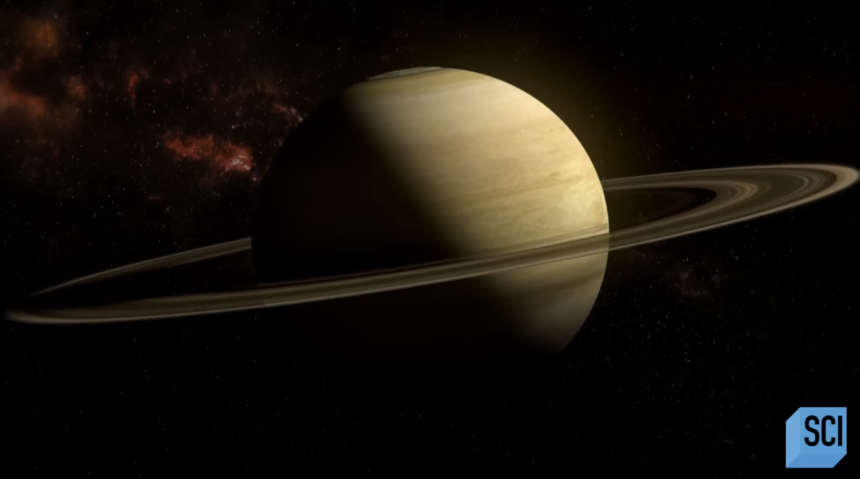
A mysterious moon got ejected near Titan, broke apart, and formed the rings we see today but the story gets even more complicated
Saturn’s rings have been captivating astronomers since Galileo first looked through a telescope in the early 1600s, but we’ve only recently figured out how they actually formed. The NASA Cassini mission spent 13 years studying Saturn and answered tons of questions about the rings, but it also raised weird new ones: Why are the rings so young? Why do so many of Saturn’s 274 moons have oddly tilted orbits? And why does Saturn’s axis wobble if its mass is so centrally located? In 2022, researchers from MIT and UC Berkeley proposed an elegant answer that explains all three mysteries: Saturn once had a moon that got ejected, collided with something, and broke apart to form the rings.
- A mysterious moon got ejected near Titan, broke apart, and formed the rings we see today but the story gets even more complicated
- Hyperion is basically the most interesting moon in the Saturn system
- But the rings are still the mystery at the center of this whole theory
- The wild part is that we might be able to verify parts of this theory soon
Researchers from the SETI Institute led by Matija Ćuk ran computer simulations to test whether this theoretical moon could get close enough to Saturn to actually create the rings. Their findings accepted for publication in the Planetary Science Journal but not yet published suggest the scenario is plausible. But here’s where it gets weird: when they ran the simulations, another Saturn moon called Hyperion kept disappearing. Except Hyperion actually exists. So something didn’t add up.
Hyperion is basically the most interesting moon in the Saturn system
It’s a small, oblong, potato-shaped satellite with a chaotic, shaggy orbit that’s somehow locked to Titan. That’s already strange. But the researchers noticed something even stranger: the Titan-Hyperion lock happened only a few hundred million years ago right around the same time their hypothetical extra moon would have disappeared from the system. That’s too much of a coincidence.
So Ćuk and his team proposed a different scenario that actually makes everything fit together. What if Hyperion didn’t survive the cosmic upheaval but resulted from it? Imagine this: a smaller “proto-Hyperion” moon and a larger “proto-Titan” moon collided and merged together, creating the Titan we know today while spewing out fragments that became Hyperion. This would explain some genuinely weird things about Titan like its eccentric orbit and the complete lack of impact craters on its surface (which should exist if there had been collisions).
But the rings are still the mystery at the center of this whole theory
Here’s how the researchers think it worked: if Titan formed from a merger between two moons, its eccentric orbit could have destabilized smaller moons closer to Saturn. Those moons would have crashed into each other in a cosmic demolition derby. Some of the resulting debris scattered inward and formed Saturn’s iconic rings. It’s elegant, it explains multiple mysteries simultaneously, and it’s based on computer simulations that actually work.
The wild part is that we might be able to verify parts of this theory soon
The Cassini mission is still dropping data that scientists are parsing, but we’re also getting ready for a new mission. NASA’s Dragonfly spacecraft is scheduled to launch in 2028 and will reach Titan in 2034. That’s when a nuclear-powered octocopter will actually touch down on Titan’s surface and collect data that could confirm whether the collision theory holds up. Galileo couldn’t have imagined this when he first saw the rings eventually, humans would send a robot helicopter to study one of the moons that helped create them.
The story of Saturn’s rings turns out to be a story of cosmic collisions and debris, two moons merging, and fragments rearranging into one of the solar system’s most beautiful features. It’s the kind of origin story that sounds like science fiction but is grounded in physics, computer modeling, and the actual weird orbital characteristics we observe today. Sometimes the universe creates its masterpieces through destruction and recombination.