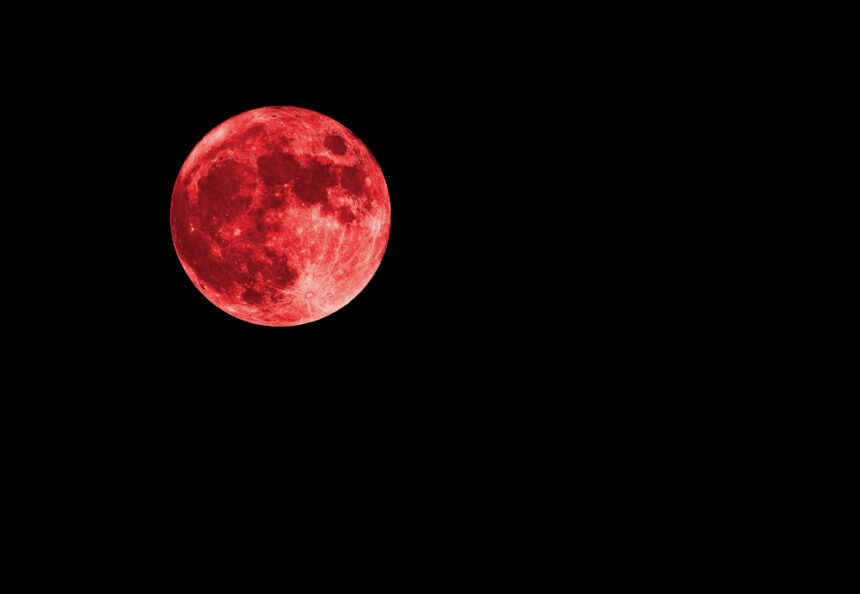
The “blood worm moon” will fade to black before glowing an eerie rust-red in one of the most accessible astronomical spectacles of the year, visible without special equipment
A celestial spectacle is coming. Early next month, approximately 3.3 billion people will have the opportunity to watch the moon fade to black and then transform into an eerie rust-red during a total lunar eclipse. Unlike solar eclipses that require specific locations and protective equipment, this lunar eclipse will be visible from nearly everywhere the moon is visible no special glasses needed, no travel to remote locations required. Simply step outside after dark on the night of March 2-3, and weather permitting, you’ll witness one of astronomy’s most dramatic phenomena.
The entire Western Hemisphere will be treated to at least some portion of this eclipse, though the spectacle definitely favors viewers west of the Pacific Ocean. From Kazakhstan eastward to Florida, observers will see at least some phase of the lunar eclipse. But a vast area spanning North America, Oceania, and Asia will experience all phases from start to finish the penumbral dimming, the partial eclipse, totality, and the return to normal moonlight.
This accessibility is what makes lunar eclipses fundamentally different from solar eclipses. Solar eclipses are only visible within a narrow band of select locations on Earth. Lunar eclipses, by contrast, are visible from wherever it’s nighttime. There’s no narrow path of totality, no requirement to travel hundreds of miles to reach the centerline. The moon itself is the canvas, and if you can see the moon, you can see the eclipse.
The Blood Moon Phenomenon
The “blood moon” phenomenon occurs because of how Earth’s atmosphere refracts sunlight. During totality, the moon will spend 65 minutes fully engulfed in Earth’s darkest shadow the umbra where no direct sunlight reaches. Yet the moon won’t disappear entirely. Instead, it will glow an uncanny red color caused by sunlight filtering through Earth’s atmosphere and refracting around the planet’s horizons.
Imagine all the sunrises and sunsets happening simultaneously on Earth, and their combined light being bent by Earth’s atmosphere to shine directly upon the moon’s surface. That’s the mechanism creating the blood moon’s crimson glow. The red coloration is literal it’s the light from every sunrise and sunset on Earth united and focused onto the lunar surface.
This blood moon appearance only occurs during totality when the moon is fully within Earth’s shadow. Partial eclipses never produce the blood moon effect because the moon isn’t completely blocked from direct sunlight. The dramatic red coloration is exclusive to total lunar eclipses.
Timing and Viewing Windows
For North American observers, totality begins at 6:03 a.m. ET on March 3, with maximum eclipse occurring at 6:33 a.m. ET. Totality ends at 7:02 a.m. ET. But timing depends on your location and time zone. In Los Angeles, totality spans from 3:03 a.m. to 4:02 a.m. Pacific Time. In Tokyo, viewers will see the blood moon from 8:04 p.m. to 9:02 p.m. Japan Standard Time on March 2.
The geographic coverage is remarkably broad. Viewers in Bangladesh, China, central Russia, Oceania, and Australia will all see the complete blood moon. Much of the Americas from North America through Central America will witness totality. However, Newfoundland, Labrador, and most of South America will miss out on the full spectacle, though some observers in places like Maine, Panama, and Ecuador might catch glimpses of the blood moon as it rises or sets.
The Broader Eclipse Event
The complete eclipse unfolds in stages. The penumbral eclipse a nearly imperceptible dimming caused by Earth’s outer shadow begins at 3:43 a.m. ET and lasts until 9:23 a.m. ET. The partial eclipse, where Earth’s umbral shadow gradually covers the moon creating a “moon cookie with a bite,” runs from 4:49 a.m. to 8:17 a.m. ET.
The numbers reveal the eclipse’s massive reach. While approximately 176 million people will witness the entire eclipse from start to finish, an incredible 5.6 billion people globally will see at least some phase of the event. That’s more than two-thirds of Earth’s population having the opportunity to observe lunar eclipse phenomena.
The “Blood Worm Moon”
Adding poetic significance, March’s full moon carries a special name among Native American traditions. Because March marks the thawing of soil and the emergence of worms and larvae signaling spring, this moon is called the “worm moon.” When the worm moon coincides with a total lunar eclipse, it becomes the “blood worm moon” combining the spring seasonal marker with the eclipse’s dramatic coloration.
The total lunar eclipse on March 2-3 represents a rare convergence of accessibility and spectacle. No equipment required. No travel necessary. Just clear skies and the patience to watch the moon transform from familiar white orb to something genuinely otherworldly.