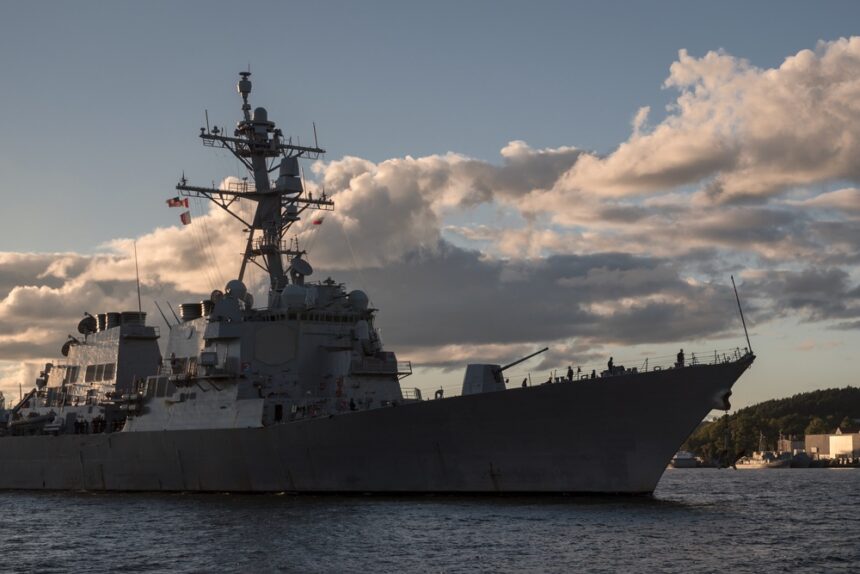
Tensions in one of the world’s most contested waterways flared again this week, this time involving an American warship.
China’s military accused the USS Charleston on Tuesday, Oct. 20, 2026, of illegally entering waters near Sabina Shoal in the South China Sea without Beijing’s approval. The Philippines rejected the claim.
What happened near Sabina Shoal?
A spokesman for China’s People’s Liberation Army said the Charleston, a littoral combat ship, intruded into waters near Sabina Shoal early Tuesday. China calls the feature Xianbin Jiao. Littoral combat ships are smaller, fast vessels designed to operate in coastal waters.
The PLA’s Southern Theater Command said it sent forces to track and monitor the American vessel. The command oversees Chinese military operations in the South China Sea region.
There was no immediate comment from the U.S. Navy.
What did China say about Sabina Shoal?
In a post on the official social media account of China’s armed forces, a military spokesperson said Beijing holds indisputable sovereignty over the Spratly Islands, which China calls Nansha Qundao, and nearby waters. The spokesperson demanded that the United States immediately stop its activities there.
China claims nearly all of the South China Sea, despite competing claims from the Philippines, Malaysia, Vietnam, Taiwan and Brunei. The waterway carries trillions of dollars in trade each year and is believed to hold rich fishing grounds and energy reserves.
How did the Philippines respond?
A Philippine military spokesperson said the Charleston did not enter Chinese territory. The ship, the spokesperson said, did not need permission for lawful passage through international waters. The Philippines and the United States are close allies, and their forces often train together in the region.
Sabina Shoal lies about 75 nautical miles from the Philippine island of Palawan, within the Philippines’ exclusive economic zone.
Under international maritime law, an exclusive economic zone gives a country rights to resources out to 200 nautical miles from its coast, while other nations’ ships may still pass through.
Why is Sabina Shoal a flash point?
The shoal has become a frequent site of confrontation. In 2024, Philippine and Chinese coast guard vessels collided there several times while Manila kept a ship stationed at the shoal for months. Each side blamed the other for the collisions.
Manila has accused Beijing of trying to block its access and possibly build structures there, which China denies. In 2024, the Philippines reported finding piles of crushed coral near the shoal and suggested they could signal land reclamation, a claim China rejected.
In 2016, an international tribunal ruled that China’s sweeping claims to the South China Sea had no legal basis. China rejected the decision and does not recognize it. The case was brought by the Philippines under the United Nations Convention on the Law of the Sea.
What does this mean for U.S. and China relations?
The United States regularly sends warships through the South China Sea to challenge what it considers excessive maritime claims. Washington and Manila are also bound by a mutual defense treaty dating to 1951. China has repeatedly condemned such operations as provocations, while the United States says they uphold freedom of navigation for all countries.
The latest encounter comes as President Donald Trump prepares to travel to China next month for the APEC summit in Shenzhen, where he has said he is open to meeting with Chinese leader Xi Jinping. Trump has also floated a meeting with Xi and Russian President Vladimir Putin on nuclear arms.
Any escalation near Sabina Shoal could complicate those talks. For now, both sides appear to be sticking to their positions, with the waters around Sabina Shoal remaining a test of competing claims.