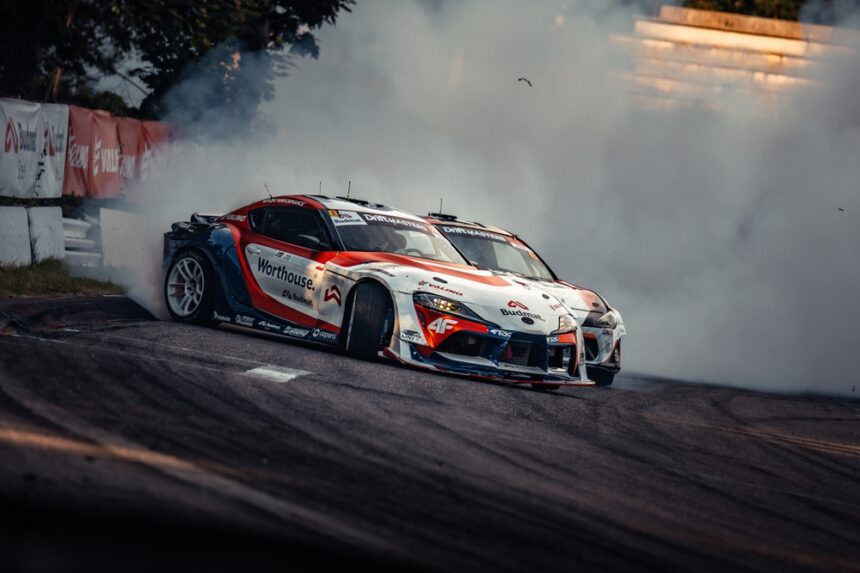
There is a moment in drift racing that no other motorsport can replicate. The car breaks traction on purpose, the rear end swings wide, smoke erupts from the tires, and the driver — fully in control — guides hundreds of horsepower sideways through a corner at terrifying speed. It lasts maybe three seconds. It feels like a lifetime.
That is drifting. And if you have never paid attention to it, you have been sleeping on the most electrifying discipline in all of motorsport.
Formula 1 has the budget. NASCAR has the tradition. Rally has the mud and the chaos. But drifting has something none of them can manufacture — pure, unfiltered style. In drifting, how you win matters just as much as whether you win. That is a standard no other racing series even attempts to hold itself to.
Why Drifting Hits Different From Every Other Racing Format
Most motorsports are decided by a clock. The fastest lap wins. The cleanest pit stop wins. The biggest engine wins. Drifting throws that entire framework out and replaces it with something far more interesting — judgment.
Drivers are scored on
- Angle — how aggressively the car is pushed sideways through a corner
- Line — how closely the driver follows the designated course path
- Speed — how much momentum is carried through the drift zone
- Style — the overall impression of control, commitment, and showmanship
That last one is the kicker. No other major motorsport scores for style. Drifting does. That alone puts it in a category of its own.
The Case Against F1, NASCAR, and Traditional Racing
Formula 1 is a masterpiece of engineering. The races, however, are often won in the factory months before the season even begins. The car with the biggest budget almost always leads the pack. Strategy, pit stops, and tire degradation decide more outcomes than actual driving talent on any given Sunday.
NASCAR brings raw energy and a passionate fanbase — but the oval format, while iconic, is a loop. Literally. The same left turns, hundreds of times.
Rally racing comes closest to drifting in terms of chaos and driver demand. But the stages are timed individually and held on closed roads away from spectators. The drama is real, but the experience of watching it live is limited.
Drifting puts everything on a single course, in real time, side by side. Two cars enter a tandem battle. One leads, one chases. The chaser has to mirror every move of the leader — matching angle, matching line, matching aggression — close enough to make contact but skilled enough not to. It is the most intense wheel-to-wheel format in motorsport, and it happens just feet away from the crowd.
Drift Culture Has Always Been Ahead of the Curve
Drifting did not start in a boardroom. It started on the mountain passes of Japan in the 1970s, where drivers like Kunimitsu Takahashi and later Keiichi Tsuchiya were pushing rear-wheel-drive machines sideways through hairpin corners not because it was faster — but because it looked and felt incredible.
That rebellious DNA never left. Drifting grew from illegal street runs to organized competition to a global phenomenon with events drawing tens of thousands of fans across Europe, Asia, and beyond. The Worthouse Drift Team, whose Toyota Supra has become one of the most recognized machines in the sport, represents exactly how far the culture has traveled — from grassroots obsession to world-class competition.
The sport does not chase legitimacy. It earns it.
Why the Next Generation Is Choosing Drifting
Younger audiences are not watching sports the same way their parents did. They want highlight reels, not hour-long broadcasts. They want personality, not just podiums. They want to feel something — not just observe a result.
Drifting delivers on all three. Every single run is a highlight. Every driver has a distinct style that fans recognize and follow. And every tandem battle carries genuine tension that no amount of production value can fake.
The smoke, the sound, the sideways aggression — it is built for the moment we are living in. Short, intense, visually explosive, and endlessly rewatchable.
If you have not found your way into drift culture yet, the door is wide open. And once you walk through it, no other motorsport will ever feel quite the same.