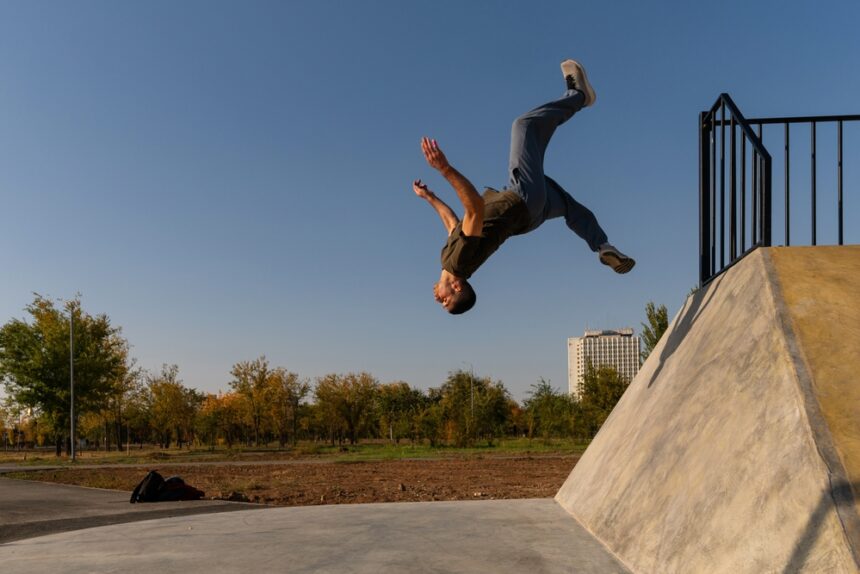
There is a moment in every beginner’s parkour journey that changes everything. It is not a massive rooftop leap or a wall-to-wall flip — it is the first time a simple vault over a park bench feels completely natural, and the world suddenly looks different. Every ledge, staircase, and concrete block stops being furniture and starts being possibility.
That shift in perspective is exactly what parkour is built on. Originating in the suburbs of Paris in the mid-1980s, parkour — rooted in the French military training method known as parcours du combattant — was developed by a group of young practitioners who called their discipline l’art du déplacement, or the art of movement. The goal was never to impress. It was to move through any environment efficiently, creatively, and with full control of the body.
Decades later, the practice has gone global, and the barrier to entry remains refreshingly low. No gear. No gym. Just movement, awareness, and a willingness to start small.
What parkour actually is — and what it is not
The practice of moving through an environment — urban, natural, or otherwise — using jumps, vaults, climbs, and balance. Practitioners are called traceurs, and the philosophy behind the sport is as much mental as it is physical. It is about reading your surroundings, solving movement problems, and building confidence one obstacle at a time.
It is worth separating this from freerunning, a related but distinct discipline. Freerunning prioritizes acrobatics and visual flair — flips, spins, aerial tricks. Parkour, by contrast, is about efficiency. Every movement has a purpose. The two share DNA but are not the same thing, and beginners are well-served starting with pure parkour fundamentals before chasing anything aerial.
Building the foundation before the first jump
The most common mistake new practitioners make is rushing toward the flashy stuff. Parkour rewards patience. Before attempting any obstacle, building baseline strength and body awareness is essential. A solid starting routine includes
- 25 push-ups, 5 pull-ups, and 50 squats to establish foundational strength
- Balance work — walking rails, practicing stillness on elevated surfaces
- Light jogging and dynamic stretching before every session
- Falling practice on soft ground to train the body to absorb impact safely
The physical demands of parkour draw heavily on calisthenics, and the two disciplines complement each other naturally. Strength built through bodyweight training translates directly into better vaults, cleaner landings, and more controlled movement overall.
The five essential parkour moves for beginners
Every traceur starts in the same place. These are the five foundational movements that form the base of any parkour practice
- Precision jump — Jumping from one specific point to another with full control. Arms forward for balance, deep squat for power, land on the balls of both feet with knees bent to absorb impact.
- Safety landing — The non-negotiable skill. Land on two feet, shoulder-width apart, knees over toes, bending no further than 90 degrees. Soft landings protect joints and allow immediate continuation of movement.
- Safety roll — Used when dropping from height or carrying forward momentum. Tuck the chin, roll diagonally across one shoulder to the opposite hip. Practiced first on grass or gym mats until it becomes instinct.
- Safety vault — The entry-level vault. Approach a low obstacle, plant one hand and the opposite foot, and bring the trailing leg through cleanly. Land softly and continue moving.
- Wall run and climb-up — Approaching a wall with momentum, planting a foot to generate upward drive, and pulling the body up using upper body strength. Low walls first, always.
Safety, mindset, and the parkour community
Parkour has a reputation that does not fully match the reality of how it is practiced. The YouTube clips that go viral represent years of methodical, conservative training — not reckless spontaneity. Every experienced traceur will say the same thing— master the basics, train with others, and never attempt a move you are not fully prepared for.
Finding a local group or jam is one of the best ways to accelerate progress safely. The community is notably welcoming and non-competitive. The goal is collective improvement, not one-upmanship. Gyms, available in many cities, offer structured environments with trained instructors — an excellent starting point for those who want guidance before taking to the streets.
The sport is also genuinely for everyone. People in their 30s, 40s, and beyond have built meaningful practices by starting slow and scaling to their level. Age is not a barrier. Ego is.
Why parkour stays with you
What makes parkour unlike almost any other fitness discipline is that it changes the way you see the world permanently. A flight of stairs is never just stairs again. A low wall becomes a vault opportunity. A park becomes a training ground. The sport builds strength, coordination, spatial awareness, cardiovascular health, and confidence — all without a single piece of equipment.
More than anything, parkour gives back something that most adults quietly lose somewhere along the way— the instinct to move freely, play without rules, and see the environment not as something to navigate around, but as something to move through.