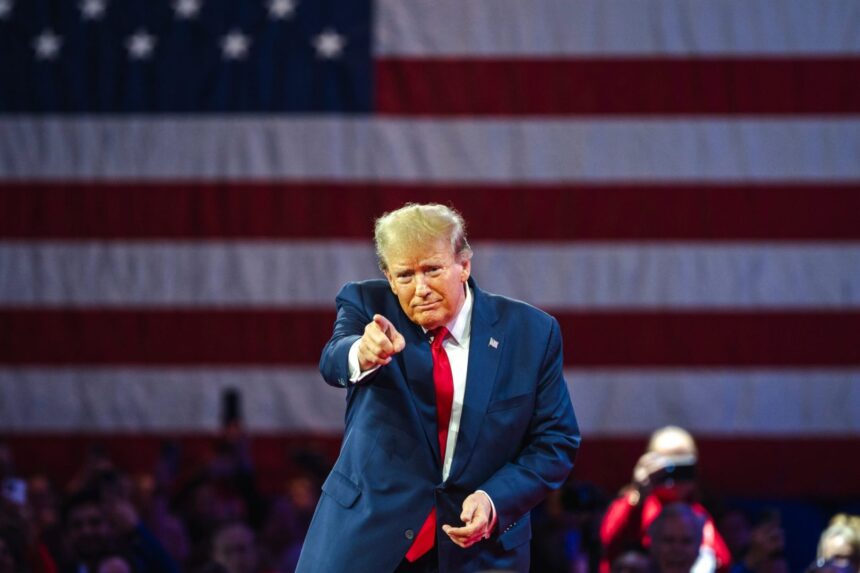
At a Kentucky rally, the president’s repeated mockery of opponents’ physical abilities drew sharp scrutiny from disability experts.
At his first major rally following the United States and Israel’s military campaign against Iran, President Donald Trump covered a lot of ground. He promoted his economic record, celebrated the military operation and, perhaps inevitably, turned his attention to the way his political rivals move their bodies.
Standing before a crowd in Kentucky, Trump described his own cautious approach to navigating rain-slicked stairs, explaining that slowness was simply the smart play. He then pivoted to former President Barack Obama, offering what he framed as admiration for the way Obama descends stairs before quickly walking it back and calling the style unpresidential. From there he moved on to Joe Biden, lingering on the former president’s well-documented stumbles and suggesting that the world watches those moments and draws conclusions.
It was not the first time Trump has circled back to this particular subject. His fixation on how opponents physically carry themselves has appeared across multiple speeches over the years, and disability researchers say the pattern reflects something more significant than political point-scoring.
Ableism and what it actually means
The behavior Trump is exhibiting fits a broader framework that scholars call ableism, a system of thinking that treats certain bodies and minds as the default standard while pushing those that differ outside the boundaries of full participation and respect. The underlying assumption is that physical limitation in one area signals a general kind of weakness or incompetence that bleeds into everything else.
That logic shows up in subtle ways across everyday life, not just in political rhetoric. It surfaces when someone instinctively speaks louder or slower to a person using a wheelchair, as though difficulty walking automatically means difficulty hearing or thinking. It shapes how workplaces are designed, how media covers aging politicians and how voters assess a candidate’s fitness for office.
When someone in a position of power uses physical stumbles or mobility challenges as a rhetorical weapon, it reinforces the idea that those qualities are legitimate measures of a person’s worth. That framing, experts argue, is not just unkind. It is a reflection of how ableism operates as a value system rather than simply a collection of rude remarks.
The problem does not belong to one side
At the same rally, Trump also took aim at California Governor Gavin Newsom’s dyslexia, framing it as evidence of mental deficiency and suggesting it disqualifies him from serious consideration. Researchers are quick to point out that a learning disability has no bearing on someone’s capacity for complex reasoning or leadership.
What followed illustrated how ableist thinking can spread across the aisle. Newsom fired back on social media with language that disability advocates flagged as equally problematic, using outdated terminology rooted in offensive diagnostic history. The exchange became a kind of case study in how reflexive ableism can operate even among those pushing back against it.
Representative Ilhan Omar navigated this tension more deliberately a few years ago. She posted a joke about Trump’s own difficulties on stairs, then deleted it and publicly acknowledged that mocking someone’s physical abilities is not a legitimate form of political criticism regardless of the target.
Ableism where it counts most
The most substantive case against Trump’s record does not require any commentary on how he walks or what his physical condition suggests about his mind. The policy record speaks clearly on its own.
Workers with disabilities were disproportionately affected by federal layoffs carried out during the current administration. Protections designed to limit discrimination against disabled employees in the workplace have been scaled back. Budget decisions affecting the Department of Education’s special education functions put services relied on by millions of children at risk. Researchers and advocacy organizations tracking these changes describe the cumulative effect as a systematic withdrawal of support from one of the country’s most vulnerable populations.
That record offers more than enough material for critics looking to hold the administration accountable. The conversation about ableism ultimately matters most not in the moments after a rally, but in the policies that outlast them.