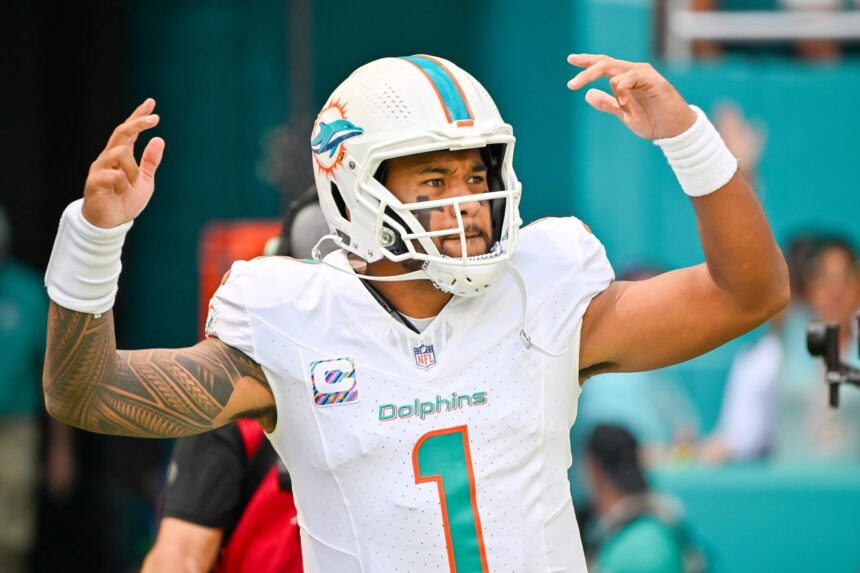
The Atlanta Falcons made one of the most eyebrow-raising moves of the NFL’s busiest week, signing free agent Tua Tagovailoa under new head coach Kevin Stefanski — a decision that landed with a thud among executives around the league.
Stefanski, a two-time Coach of the Year with the Cleveland Browns and a well-regarded developer of quarterbacks, was expected to bring stability to Atlanta’s offense. Instead, his first major move left many in the league shaking their heads.
A Roster Built to Win — With the Wrong Signal-Caller
The Falcons boast one of the more enviable offensive rosters in the NFC. Elite skill players. Versatile weapons. A system that, in the right hands, could genuinely threaten for a Super Bowl run. But unlocking that potential requires a quarterback who can stretch the field vertically and attack all four quadrants of the defense.
Tagovailoa, by nearly every measurable standard, is not that quarterback.
Over the past two seasons, he averaged just 6.2 air yards per attempt — ranking dead last, 33rd out of 33 qualified passers. He also ranked 32nd in the percentage of attempts traveling 15 or more yards downfield and 27th in touchdown-to-interception ratio. His reliance on short, high-traffic throws near the line of scrimmage not only limits big-play potential but puts pass catchers in harm’s way.
Why Tagovailoa’s Red Flags Worried NFL Executives
The concerns extend well beyond raw statistics. Multiple executives who evaluated the full quarterback market this offseason flagged Tagovailoa’s road struggles, his medical history, his leadership profile, and the circumstances surrounding his departure from Miami — where the Dolphins absorbed a $53 million dead-cap hit just to move on from him. Miami then turned around and committed roughly $25 million per season to Malik Willis as his replacement.
That context made Atlanta’s decision even harder to digest for those around the league.
- Tagovailoa ranked last in air yards per attempt among all qualified passers over the last two seasons
- He ranked 32nd in deep passing percentage (15-plus air yards)
- He ranked 27th in TD/INT ratio
- Miami absorbed a $53M cap hit to release him
- The Falcons signed him at a $1.3M veteran deal
Cousins vs. Tagovailoa — What the League Really Thinks
What stings most for outside observers is what the Falcons walked away from. Kirk Cousins, the quarterback Atlanta handed a massive contract just two years ago, was still on the market. Executives widely viewed Cousins as the sharper fit for Stefanski’s play-action-heavy scheme — a system that rewards quarterbacks who can push the ball downfield with purpose.
One general manager actively shopping for a quarterback put it plainly— Cousins fits this offense better. Tagovailoa came with too many red flags to seriously consider. Several others echoed that sentiment, pointing to Cousins’ familiarity with structured, run-pass-option systems as a natural match for what Stefanski has historically built around his signal-callers.
Another executive, equally baffled, questioned whether Atlanta’s quarterback room is even better now than it was at the end of last season — a damning indictment of a move made in the opening hours of free agency.
Tagovailoa and Penix — An Awkward Room
The situation is further complicated by the presence of Michael Penix Jr., a former first-round pick who has yet to develop into the franchise cornerstone Atlanta hoped for. Adding Tagovailoa — with his complicated baggage and a well-documented tendency to operate outside conventional norms — introduces fresh tension into a room already searching for direction and a clear identity at the most important position on the field.
Whether Stefanski can reshape Tagovailoa’s habits and coax something more out of his arm remains to be seen. But if the early reaction from around the NFL is any indication, Atlanta’s gamble is already starting from a deficit of confidence.
Source: SportsBoom