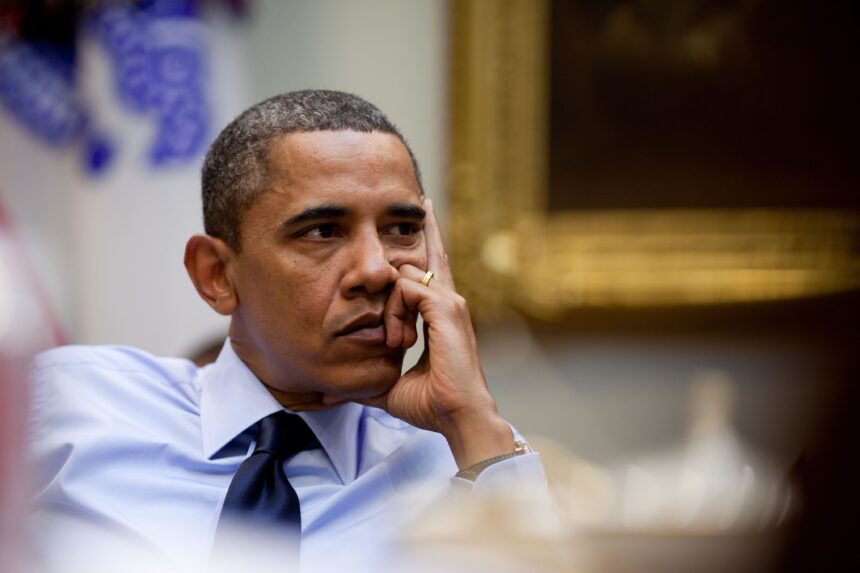

The House of Hope on Chicago’s Far South Side filled with thousands of mourners, activists and political figures on a day that brought together some of the most significant names in American public life to honor the legacy of Rev. Jesse Louis Jackson. Former President Barack Obama delivered the defining address of the occasion, with former President Joe Biden, former President Bill Clinton and former Vice President Kamala Harris among those in attendance. Performer Jennifer Hudson added an emotional musical dimension to a gathering that carried the weight of both grief and purpose.
Jackson, whose career spanned six decades of civil rights activism, presidential campaigns and international diplomacy, left behind a legacy that Obama described as still very much alive and in motion not a finished chapter but an ongoing charge passed to each generation that follows.
Obama draws a direct line between Jackson’s fight and today’s challenges
Obama’s remarks were personal before they became political. He shared the memory of being a college student in 1984 when Jackson ran for president, describing the experience of watching a Black man compete seriously for the nation’s highest office as a formative moment that reframed what was possible. Jackson’s candidacy, Obama recalled, demonstrated that outsiders could belong anywhere in American public life a lesson that shaped his own understanding of representation and possibility long before he entered politics himself.
From that personal foundation, Obama moved to the larger stakes of the moment. Without naming former President Donald Trump directly, he painted a portrait of a political environment defined by fear, division and the deliberate weaponization of anxiety among the public. The current climate, he said, is one in which those in high office encourage Americans to fear one another a dynamic he framed as a direct assault on the democratic values that Jackson spent his life defending.
A eulogy that became a rallying cry
What made Obama’s address notable was not simply its critique of the political present but the way it transformed grief into a directive. He framed Jackson’s life not as something to be mourned but as a standard to be met a model of resilience, activism and refusal to accept injustice as inevitable. The message delivered to those in the pews and watching from across the country was that honoring Jackson meant continuing his work rather than memorializing it from a safe distance.
Obama acknowledged directly that the current moment can make hope feel difficult to sustain. The daily pressures on democratic institutions, the erosion of civic norms and the normalization of rhetoric that divides rather than unites can wear down even the most committed activists. But he argued that Jackson’s entire career was built on the refusal to surrender hope in exactly those kinds of conditions and that the inheritance Jackson leaves behind is precisely that refusal.
The figures who came together to pay their respects
The presence of Biden, Clinton and Harris at the service reflected the scope of Jackson relationships across decades of Democratic Party politics and civil rights history. Jackson was not simply a figure from a particular era but a connective thread running through more than half a century of American political life, someone who had relationships with every Democratic president from Jimmy Carter forward and who shaped the party’s understanding of its obligations to Black voters and marginalized communities.
That gathering of former presidents and vice presidents in a South Side Chicago church also carried its own symbolic weight in the current political climate a visible demonstration of continuity and collective memory at a moment when both are under strain.
What Obama asked of the next generation
The closing thrust of Obama remarks was directed not backward at what Jackson had achieved but forward at what remained to be done. He identified younger generations as the primary inheritors of Jackson activist tradition, pointing to the ways in which organizing, advocacy and community engagement have taken new forms without losing the essential character that Jackson embodied throughout his career.
The ask was not abstract. Obama called on those present and by extension those watching to be, in his framing, heralds of change and messengers of hope. The specific language was drawn from Jackson own rhetorical tradition, a deliberate choice that connected the call to action directly to the man being honored rather than allowing it to float free as generic inspiration.
For a gathering assembled to mourn one of the most consequential figures in American civil rights history, Obama words ensured that the occasion ended not in elegiac reflection but in the kind of urgent, forward looking energy that Jackson himself would likely have demanded.