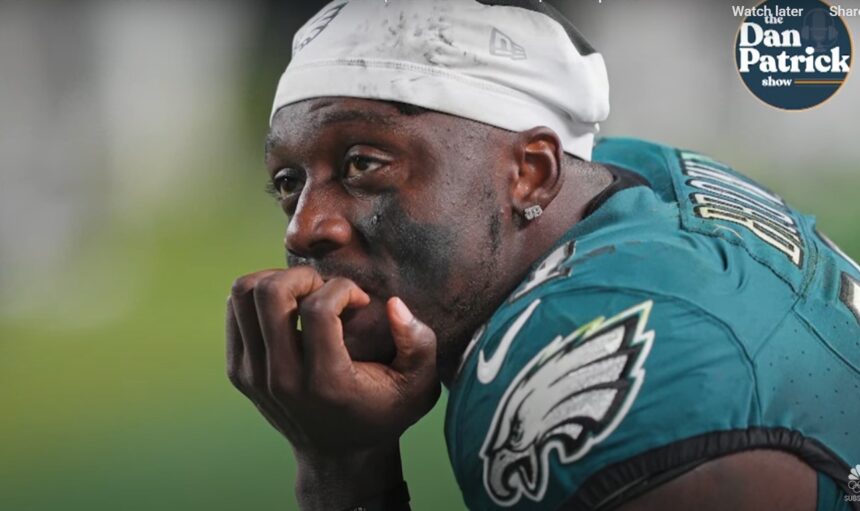
The Philadelphia Eagles are open to dealing their star wide receiver — but the cost will make most teams think twice before picking up the phone.
As the new NFL league year draws closer, the Eagles find themselves at the center of one of the most talked-about roster situations in the league. Wide receiver AJ Brown has emerged as a serious trade target for multiple teams, with several franchises already making their interest known to Philadelphia. The Eagles have not slammed the door shut — but they have made one thing crystal clear. Getting Brown will cost a king’s ransom.
The benchmark being used is no accident. General manager Howie Roseman is measuring any potential Brown deal against the blockbuster trade that sent defensive tackle Quinnen Williams from the New York Jets to the Dallas Cowboys. That package included a future first-round pick, a second-round pick, and defensive lineman Mazi Smith. Williams had previously signed a $96 million extension, making him one of the highest-paid players at his position at the time of the deal. Philadelphia is signaling to the rest of the league that Brown’s value sits in that same stratosphere — and then some.
What Brown Brings to the Table
The Eagles‘ steep asking price is a direct reflection of what Brown has consistently delivered on the field. In 2025, the veteran receiver hauled in 78 passes for 1,003 yards and 7 touchdowns, maintaining the elite production that has made him one of the most dependable No. 1 targets in football for several seasons running.
Across seven NFL seasons, Brown has earned three Pro Bowl selections and All-Pro recognition, establishing himself as a genuine difference-maker at the position. He is not a rental. He is not a project. He is a proven commodity under contract through 2026 at $29 million — a figure that reflects both his on-field value and the financial weight any acquiring team would be taking on.
Roseman has built his reputation around adding talent, not subtracting it. The Eagles are not believed to be pushing for a trade. A more accurate read of the situation is that Philadelphia is willing to listen — but only to the right conversation.
The Williams Deal as a Reference Point
Anchoring Brown’s price to the Williams trade is a deliberate and pointed message to the rest of the league. That deal was widely seen as a high-value return for a player entering a complex contract situation, and by framing Brown in those same terms, the Eagles are drawing a clear line in the sand.
The parallel holds up under scrutiny. Brown, like Williams at the time of his trade, is an established Pro Bowl performer on a substantial contract whose impact for the acquiring team would be immediate. A package anchored by a first-round pick with a second-round addition is the floor — not the ceiling — of what Philadelphia is entertaining. Teams that cannot meet that threshold need not apply.
A Waiting Game With Real Consequences
The uncertainty surrounding Brown is already creating complications elsewhere in the Eagles’ offseason. His $29 million salary commitment for 2026 has reportedly made ongoing contract discussions with tight end Dallas Goedert more difficult to navigate. Managing two significant contract situations simultaneously is the financial puzzle Roseman is trying to solve as free agency opens.
For now, the Eagles appear content to be patient. If a team steps up with an offer that clears their benchmark, things will move fast. If no one meets the price, Brown could very well be suiting up as the centerpiece of another deep Philadelphia playoff run in 2026 — an outcome the Eagles would have no complaints about whatsoever.
Either way, Roseman holds all the cards. And he knows it.